
Fast Charging Infrastructure: Building the Energy Backbone of Electric Mobility
Ad
From charging speed to infrastructure capacity
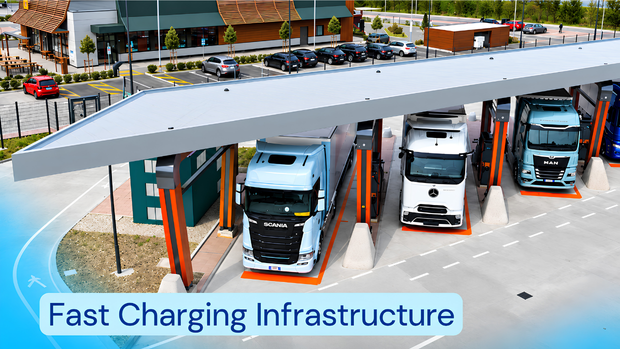
Electric mobility is entering a new phase in Europe.
For passenger vehicles, fast charging is already becoming part of everyday mobility, supporting long-distance travel, retail destinations, mobility hubs and high-traffic public sites. For professional fleets, buses, utility vehicles and freight operators, the challenge is even more operational: charging must fit into business schedules, vehicle rotations and increasingly demanding service commitments.
At the same time, electricity demand is accelerating. In July 2026, the International Energy Agency forecast global electricity demand to grow by 3.6% in 2026 and a further 3.8% in 2027, driven by industry, transport, cooling and data centres. As mobility becomes increasingly electrified, charging infrastructure is adding a new layer of high, localised and often simultaneous power demand to Europe’s energy systems.
This makes fast and ultra-fast charging a strategic infrastructure issue.
The question is no longer simply where to install chargers. It is how to deliver sufficient power quickly, reliably and at scale.
Heavy-duty transport makes this challenge particularly visible. Freight operators cannot afford long charging stops. The shorter the charging window, the higher the power required to deliver enough energy without disrupting fleet operations. But this logic is increasingly extending beyond freight: wherever time is constrained, power becomes critical. And wherever power becomes critical, the infrastructure behind the charger becomes decisive.
Freight as the stress test for fast charging
The charging requirements of an electric truck are fundamentally different from those of a passenger car.
For long-haul transport, charging must be fully integrated into the vehicle’s operating cycle. High-power DC charging already delivers several hundred kilowatts, while Megawatt Charging Systems (MCS) are emerging to push beyond the 1 MW threshold. The objective is straightforward: deliver enough energy during a short stop to keep vehicles on the road with minimal operational disruption.
This is why freight is not the only use case for fast charging infrastructure, but it is often the most demanding. It concentrates all the key constraints of the sector: high power, limited downtime, simultaneous charging, grid limitations, site constraints and long-term scalability.
This is also where real-world projects start to show what is required in practice. In Southern Europe, for example, TSG has supported the deployment of the first Megawatt Charging System for heavy-duty vehicles for Grupo Disfrimur in Spain, reaching up to 1,440 kW. The project illustrates how ultra-high-power charging is already moving from concept to operational reality in freight applications.
In parallel, depot-based solutions such as the high-power charging station delivered for Gautier Fret Solutions in France show another dimension of the challenge: integrating a 400 kW system (scalable to 600 kW) with a 1,250 kVA transformer and full electrical infrastructure, designed around fleet operations and future growth.
Across both cases, the conclusion is the same: the transition to electric freight is not only about vehicles and chargers. It depends on the infrastructure that connects, powers and orchestrates them.
The infrastructure behind the charger
A high-power charging project is first and foremost an electrical infrastructure project.
Before any equipment is installed, operators must assess available grid capacity and future energy needs. Depending on the site, this can involve new grid connections, medium- or high-voltage infrastructure, transformers, electrical distribution systems, battery storage, solar generation, civil works and digital supervision.
The transformer plays a central role. Its sizing must reflect not only the charging infrastructure itself, but also the site’s overall electricity consumption and future expansion. This becomes even more critical when multiple vehicles charge simultaneously or when charging hubs are designed to scale over time.
A charging site cannot be designed by simply adding up charger power ratings. The full electrical architecture must take into account load profiles, simultaneity factors, grid constraints and operational patterns.
Site layout is equally important. Heavy-duty vehicles require sufficient space for circulation and manoeuvring, while the positioning of chargers, electrical rooms and transformers must ensure safe and efficient operations. On retail or mobility hub sites, this also directly impacts user experience and site performance.
This is why TSG’s Charge approach is built as an end-to-end integration model: from technical design and permitting to grid connection, electrical and civil works, commissioning and long-term maintenance. Depending on project needs, TSG also integrates complementary technologies such as transformers, battery storage, solar production and energy management systems.
Managing power when the grid is constrained
One of the main bottlenecks in deploying fast charging infrastructure is access to sufficient grid capacity.
Even when demand is clear and the site is well located, the local network may not immediately support the required power levels. Grid reinforcement can take time, creating a gap between operational needs and available infrastructure.
This is where flexibility becomes essential.
Battery storage systems can bridge this gap by storing energy when demand is low or when on-site solar production exceeds consumption, and releasing it during peak charging periods. This helps reduce peak loads and optimise the use of the available grid connection.
Energy management systems add another layer of control. By monitoring real-time consumption across the site, charging power can be dynamically adjusted based on available capacity, operational priorities and other electrical loads.
TSG’s EnergyHUB solution reflects this integrated approach. By connecting charging infrastructure, grid supply, photovoltaic production, battery storage, building systems and other energy assets into a single cloud-based platform, EnergyHUB enables operators to monitor, control and optimise energy flows across the entire site. Dynamic load management, peak shaving and self-consumption optimisation help ensure operational continuity while maximising infrastructure efficiency.
In practice, this means that the value of a charging site is no longer defined only by installed power, but by how intelligently that power is managed.
A clear example of this approach can be seen in the Netherlands, where TSG and Pixii integrated a 150 kW fast charger with battery storage on a site limited to a 40 kVA grid connection. The system effectively decouples charging demand from grid constraints, enabling operations that would otherwise not be possible.
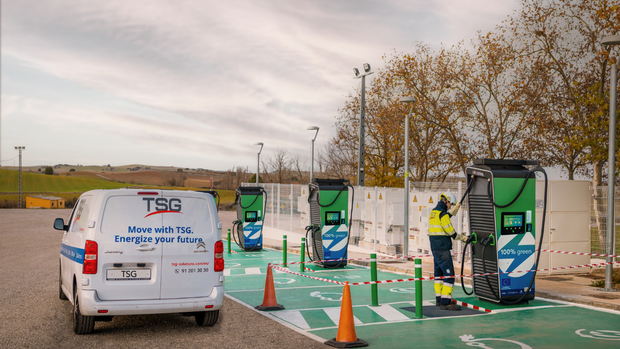
From depots to corridors: infrastructure in real conditions
Fast charging infrastructure takes different forms depending on how and where vehicles operate.
At logistics depots, charging is typically synchronised with fleet schedules, allowing vehicles to recharge during loading, unloading or rest periods. Along major transport corridors, public charging hubs must support multiple vehicles with minimal waiting times. On mixed-use mobility sites, fast charging coexists with retail, energy distribution, solar production and payment systems, requiring a highly integrated technical approach.
This diversity is reflected in TSG’s projects across Europe.
In the Netherlands, at WattHub Geldermalsen, TSG delivered a large-scale fast-charging hub for electric trucks and off-highway vehicles. The site combines 36 Kempower Satellite chargers, six 600 kW transformers and a total capacity of 3.6 MW, demonstrating how charging infrastructure is evolving into fully-fledged energy hubs combining high power, renewables and dynamic load management.
In Italy, TSG supported Milence in the development of its first charging hub in the country, located at Bagnolo San Vito near the A22 motorway. The site, equipped with 400 kW charging infrastructure and designed for future MCS deployment, is part of a broader European corridor strategy for electric freight.
These projects, together with earlier deployments in Germany and Spain, illustrate a key point: there is no single model for fast charging infrastructure. Each site must be designed around its operational reality, whether it is a private depot, a public corridor or a multi-energy mobility hub.
Designing for the next generation of electric mobility
High-power charging infrastructure is a long-term investment.
Vehicle technologies will continue to evolve, fleet sizes will increase and charging demand will grow in both scale and complexity. Infrastructure must therefore be designed with future expansion in mind, not only current requirements.
This means anticipating additional chargers, higher power levels, increased simultaneity and evolving grid conditions. It also means designing infrastructure as a system: grid connection, transformers, distribution, charging equipment, storage, solar and energy management working together from the outset.
This integrated approach reflects the broader evolution of TSG. Over time, the Group has expanded its expertise across electric mobility, electrical infrastructure, solar energy, battery storage and energy management, combining organic growth with targeted acquisitions across Europe. Its local technical teams enable TSG to deliver end-to-end solutions while maintaining proximity to customers in each market.
As fast charging scales, mobility sites are increasingly becoming energy hubs. Their performance will not be defined solely by installed charging power, but by their ability to connect, balance and optimise energy flows over time.
For electric freight, the challenge is no longer simply to charge a truck. And for fast charging infrastructure as a whole, the challenge is no longer simply to install chargers.
It is to deliver the right amount of energy, at the right power, at the right time, reliably, efficiently and at scale.