Op-ed: Balancing legacy systems and innovation
Alex Sanchez, Lead Business IT Infrastructure Expert at Q8 and MobilityPlaza's 2026 Technology Ambassador, explores the challenge of keeping legacy systems running while still making room for innovation.

In IT, there is an old saying: "If it works, don't touch it." While this philosophy often makes sense in software development and operations, it can also have an unintended consequence: the steady accumulation of technical debt.
Across industries, organizations continue to rely on legacy systems - outdated hardware, software, and infrastructure that remain critical to daily business operations. Despite their age, these systems often sit at the heart of core processes and contain decades of business knowledge. Research suggests that nearly a third of an organization's technology landscape can be considered legacy, with these systems consuming between 60% and 80% of IT budgets.
The mobility and fuel retail sector is no exception.
When customers visit a modern service station, they are greeted by innovations such as self-service payment terminals, mobile applications, digital loyalty programs, and unmanned checkouts. These technologies create the impression of a highly modern environment. Yet beneath the surface, many organizations still depend on aging systems hidden underground, tucked away in technical rooms, or quietly running in data centers and office server rooms. The customer rarely sees them, but they remain essential to business continuity.
What defines a legacy system?
Legacy systems share a familiar set of traits: they run on outdated platforms, often coded in older languages such as COBOL, which still powers many core banking systems today. They are increasingly costly to maintain, dependent on a shrinking pool of specialized experts, and only thinly supported (if at all) by vendors, while struggling to scale with evolving business needs. These systems may still perform their intended function, but as organizations modernize, that function comes at a growing cost.
The challenges of legacy technology
1.Rising maintenance costs. As technology ages, supporting it becomes more expensive. Replacement parts may be difficult to source, expertise becomes scarce, and integrations require increasingly complex workarounds.
2.Security vulnerabilities. Legacy systems frequently lack modern security capabilities. As new vulnerabilities are discovered, organizations face the challenge of protecting platforms that were never designed to withstand today's threat landscape. Applying security fixes can be costly, difficult, or, in some cases, impossible.
3.Performance limitations. Business demands evolve faster than legacy platforms. Systems originally built for a different era often struggle to handle modern workloads, changing customer expectations, and real-time data requirements.
4.Integration challenges. Innovation thrives on connectivity. However, many legacy systems were designed long before APIs, cloud platforms, and digital ecosystems became standard. Integrating these older technologies with modern solutions can therefore become a significant obstacle.
The reality: Legacy is not going away
Modernization is no easy task. Many of these platforms support mission-critical business functions. Documentation may be incomplete, institutional knowledge may have disappeared, and the risks associated with replacement can be substantial. Transforming a business-critical system requires careful planning, significant investment, and a clear understanding of operational dependencies.
The reality is that every organization lives with some degree of legacy technology. The real question is not whether legacy systems will exist - but how organizations can continue to innovate while managing them effectively.
Strategic planning: modernization with purpose
The first step toward achieving that balance is a structured modernization strategy. Not every legacy system requires immediate replacement, and not every old platform is a business risk. Strategic planning helps organizations determine where investments will create the greatest value.
A practical approach starts with identifying every system that qualifies as legacy, then assessing and prioritizing them by business risk, cost, security exposure, and strategic value. From there, organizations can define clear end-of-life objectives and modernization roadmaps, execute replacement or transformation initiatives in a controlled manner, and validate outcomes through rigorous testing and business acceptance. Despite this clear framework execution can still be challenging: legacy environments often carry decades of integration.
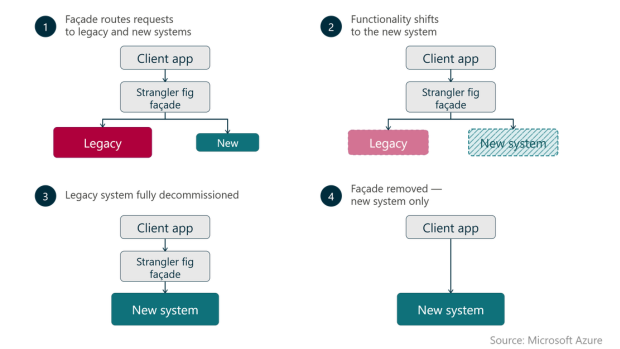
Learning from nature: The Strangler Fig Pattern
Interestingly, one of the most effective modernization approaches draws inspiration from nature.
Microsoft Azure describes the Strangler Fig Pattern, named after the tropical strangler fig tree. The fig begins life as a seed deposited on a host tree by birds or monkeys. As it grows, it gradually surrounds the host, eventually replacing it entirely.
The same principle can be applied to technology modernization.
Rather than replacing a legacy system in one high-risk transformation project, new capabilities are introduced incrementally around the existing platform. Over time, functionality is migrated piece by piece until the legacy system can be safely retired.
This approach reduces operational risk, spreads investment over time, and allows organizations to continue innovating while maintaining business continuity.
From magstripe to chip
For years, magnetic stripe cards have represented a well-known security vulnerability within mobility ecosystems, and as fraud techniques continue to evolve, relying on the technology becomes increasingly difficult to justify. A practical way to address this is by introducing new cards that support both the existing magstripe functionality and secure chip technology. This dual-interface approach mirrors the Strangler Fig Pattern: rather than replacing the entire ecosystem at once, legacy and modern technologies coexist during a managed transition period, allowing organizations to modernize at a pace that aligns with business priorities.
The strategy offers real advantages. New dual-interface cards can be issued as quickly as desired, gradually replacing the installed card base without disrupting operations, while central authorization and issuing systems process both magstripe and chip-based transactions simultaneously, ensuring compatibility throughout the transition. Field deployment, meanwhile, can be phased on its own schedule, since upgrading devices and infrastructure typically requires more time and investment, and this flexibility lets organizations align rollout with operational, financial, and commercial objectives rather than forcing a single disruptive cutover.
Beyond modernization: Creating a culture of innovation
Strategic planning and incremental modernization are essential, but they are not sufficient for long-term success. Replacing outdated technology addresses today's challenges; innovation prepares organizations for tomorrow's opportunities, and organizations that focus solely on maintaining and upgrading existing systems risk becoming highly efficient at managing the past. Avoiding that fate means treating innovation as a permanent, visible part of the corporate agenda, with dedicated investment in experimentation, new business models, and emerging technologies, even as teams keep today's systems running.
This is precisely why legacy technology deserves a different frame than an obstacle to overcome. These systems are also the foundations many businesses were built on, and the goal was never to eliminate legacy overnight; it's to manage it intelligently, through strategic planning, incremental approaches such as the Strangler Fig Pattern, and a genuine commitment to what comes next. The winners of tomorrow won't be the companies that simply keep legacy systems running, nor those that chase innovation at any cost. They'll be the ones that master the art of doing both.