Op-ed: How car wash water recycling keeps China’s fuel stations resilient
Fuel retailers on every continent watch the same curve: electric vehicles taking share of new-car sales, and fuel volume with it. Nowhere is the curve steeper than in China. New energy vehicles reached 50.8% of new-car sales in 2025, and monthly retail penetration passed 61.4% by April 2026. The National Energy Administration puts gasoline consumption more than 18% below its 2019 peak. China's fuel stations are not waiting for the slow version of this story.
What does a station sell when it sells less fuel? China has an official answer. In May 2026, the Ministry of Commerce announced a program to transform the country's roughly 110,000 fuel stations into integrated energy and service stations. The quiet workhorse of that transformation is one of the oldest machines on the forecourt: the car wash. It pulls visits on its own schedule, extends dwell time, and converts drive-by customers into repeat traffic. But it runs on water, and in China, water is now where cost, license and reputation converge.
1. The frequency engine under pressure
The pressure is measurable. Average daily throughput per Chinese station fell from about 12 tonnes of fuel in 2019 to under 8 in 2025. Yet Sinopec's 2024 results show non-fuel gross profit of RMB 11.5 billion (about US$1.6 billion), up RMB 0.9 billion year-on-year while fuel marketing income fell. Its Easy Joy brand alone runs over 10,000 car-wash sites washing 150 million vehicles a year for 40 million-plus users, and the build-out is accelerating: 1,044 wash points in Jiangsu, 650 in Shandong, 117 automatic machines among Shanghai's 570 Sinopec stations.
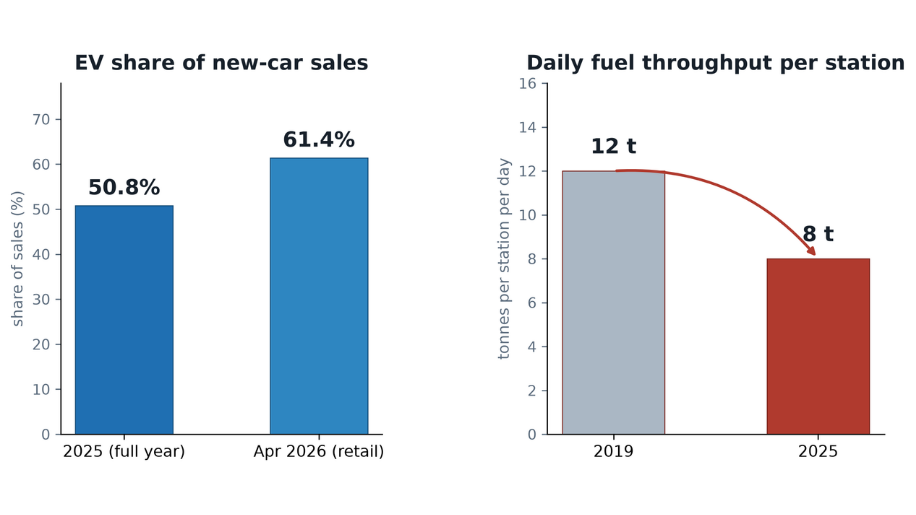
Fig. 1 — China's fuel stations under pressure. EV share of new-car sales rose from 50.8% in 2025 to 61.4% by April 2026 (left), while average daily fuel throughput per Chinese station fell from about 12 tonnes in 2019 to under 8 tonnes in 2025 (right).
The wash is not an amenity; it is the frequency engine, the most human touch point on the forecourt. Drivers rarely plan a trip to a fuel station, but they do plan a clean car. Deliver one, and the mood it leaves returns on a schedule no loyalty app can enforce.
Free is the point. Most washes are complimentary, stations give the wash away to pull fuel traffic, turning the three minutes the customer spends watching the machine into a full-disclosure moment for the brand. Waiting by the bay, the driver takes in details: whether staff greet the queue, whether the bay is clean, whether the water is visibly recycled, or wasted. The station auditions for the next visit with every car it washes, and a reputation no advertisement could buy, or a customer lost for good.
One leading equipment maker documents a Chinese station where a tunnel wash lifted fuel sales by five tonnes a day and wash volume from 100 to 400 cars, while neighboring stations' sales halved in 2025. Vendor case studies deserve skepticism, but the direction is corroborated by every operator I know: sites with a good wash hold traffic that fuel-only stations steadily lose.
2. Water: the metric that counts twice
For a fuel retailer, water is the only wash metric that appears twice on the scorecard, a cost line that can be optimized, and a license condition that cannot be negotiated. Everything else can be traded off; a breached quota simply closes the business.
The cost side is unforgiving arithmetic. In Beijing, car washing is billed as special-industry water at RMB 160 per cubic meter. Wash a car at unregulated 100–200 liters and water alone costs RMB 16–32, more than street-side operations charge. At 18 liters, it is under RMB 3. The same logic drives the world's best equipment: WashTec's gantry systems run on 14–30 liters of fresh water per wash with German type approval and live metering; Spain's ISTOBAL pushes membrane-bioreactor recycling to near-zero discharge; Germany and Austria legally require ≥80% recycling. Beijing's advanced quota of 18 liters sits on the same engineering frontier.
Tariffs are set city by city, Beijing's is RMB 160 per cubic meter, Zaozhuang's RMB 5.30, so the payback of recycling scales with the local water price
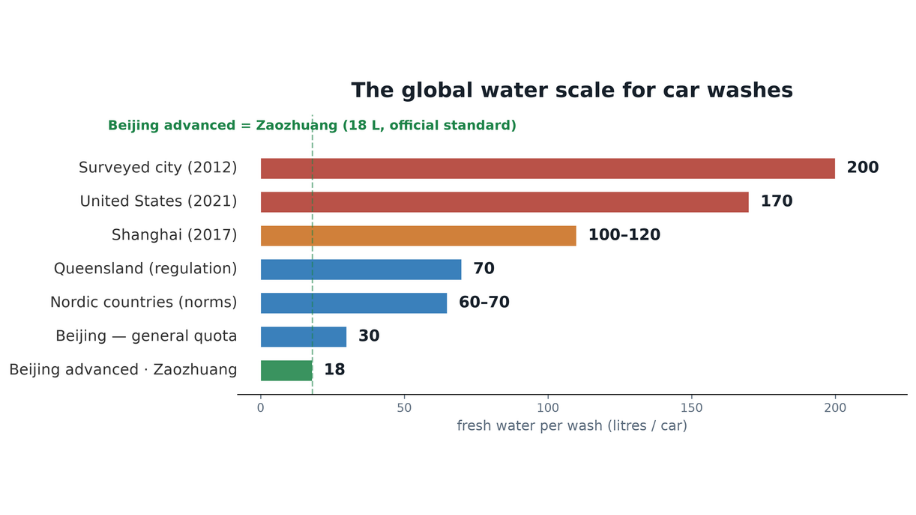
Fig. 2 — The global water scale for car washes. Fresh water per wash ranges from about 200 L for traditional washing in a surveyed city (2012 municipal estimate) and ~170 L on average in the United States (ICA research, 2021) down to Beijing's advanced quota and Zaozhuang's verified 18 L (2025).
3. Regulation arrives
China's rules tightened in three steps. In 2020, Beijing set a local water quota, advanced automatic washes at 18 liters of fresh water per car; and made recycling equipment a condition of operation. In 2023, the city's Water-Saving Regulation attached fines of RMB 10,000–50,000, logging 23 violations on day one. On 1 August 2026, the first mandatory national quota for car washes took effect across the Yellow River basin, automatic washes capped at 20–32 liters, enforceable under the Yellow River Protection Law.
A Beijing shop measured at 500 liters per car had recycling equipment installed, then switched off, while tapping a residential line. In 2024, prosecutors opened public-interest cases against twelve dealerships for evading the special tariff. The market gap remains wide: official estimates put ordinary washing in Shanghai at 100–120 liters per car (2017) and traditional washing in a surveyed city at 200 (2012 municipal estimate). Every non-compliant site in a tightening system is a retrofit sale waiting for a verified machine.
4. Proof points: the numbers that close
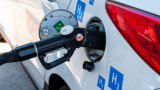
Start with the picture: a working Chinese station where fuel dispensing, car washing and rooftop solar share one site. It is not the source of the numbers below, it is what a metered, quota-compliant station looks like. The first such meter is in Zaozhuang, Shandong.
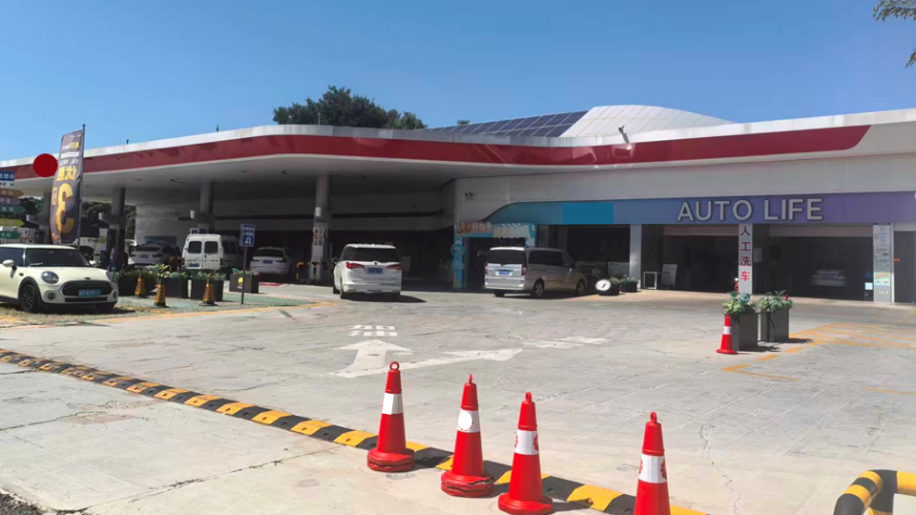
Fig. 3 — A working example, in one frame. A Beijing energy station brings fuel dispensing, a car-wash bay and rooftop solar onto one site — the same type of station the water-loop figures below come from. Photo by the author, Beijing, September 2026.
The best Chinese cases survive an owner's audit. A PetroChina site in Zaozhuang, Shandong, verified by the municipal water bureau in 2025, runs at 18 liters per car with 70% recovery, saving 3,000 cubic meters a year. At the district's special-industry tariff of RMB 5.30 per cubic meter for car-wash water, that alone is about RMB 16,000 (US$2,200) a year off the bill.
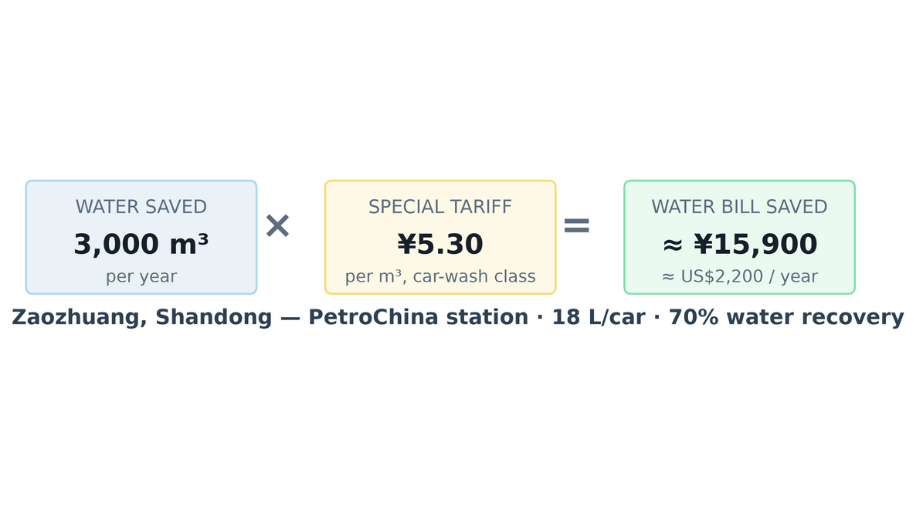
Fig. 4 — The arithmetic of one recycling loop (Zaozhuang, Shandong). 3,000 m³ of water saved per year × RMB 5.30/m³ special-industry car-wash tariff ≈ RMB 15,900 (US$2,200) off the annual water bill.
Sinopec's Nanjing operation runs 54 recycling washes handling 1.67 million washes a year, saving 7,400 tonnes; its Zhonghe Road station recycles at least 85%, saving 2,300 tonnes a year. Further south, the carbon-neutral Sinopec station at Quanzhou, Fujian, a 2012-built multi-energy hub, saves over 550 tonnes of water a year from its recycling wash alone (China News Service, July 2026).
These are not showcase numbers. They close the engineering balance: 18 liters is the number Beijing's 2020 local quota set for advanced automatic washes, and Zaozhuang's municipal water bureau verified the same figure in the field. Regulator and operator converge on 18. When the numbers close, the station has cut its water cost over 80% while keeping its license clean.
5. The trajectory is one-directional
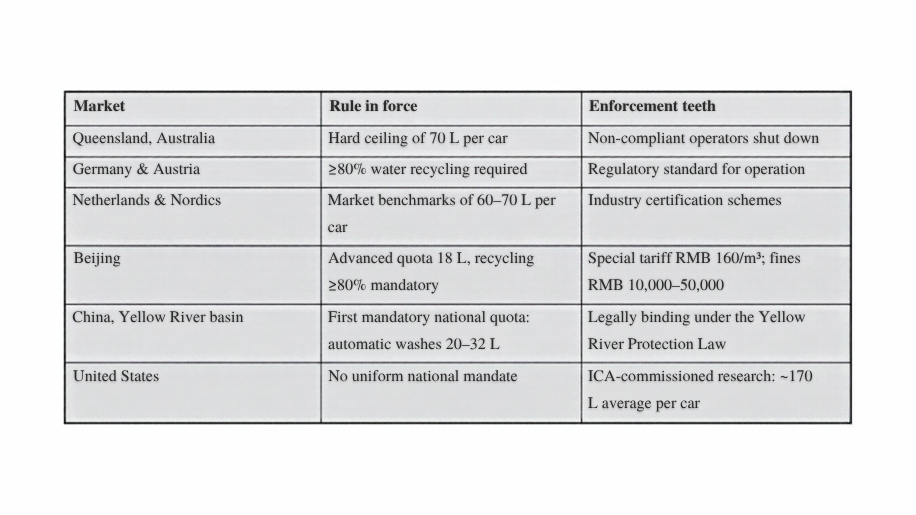
Regulation is tightening everywhere: Australia, Germany and Austria, and now China. The table below maps it market by market:
Table 1 — How the world regulates car-wash water
The equipment industry reads this as demand. WashTec's annual report expects "increasing regulation in markets with lower environmental standards or where water is scarce," creating "greater potential for environment-friendly automated car washes with water reclaim systems." Water treatment evolved in three generations. Generation one is sand filtration: it catches particles, not chemicals. Generation two is biological treatment: it digests detergents and organics, why Germany and Austria made ≥80% recycling the baseline. Generation three is the membrane bioreactor: it polishes water to near-potable quality and meters every wash.
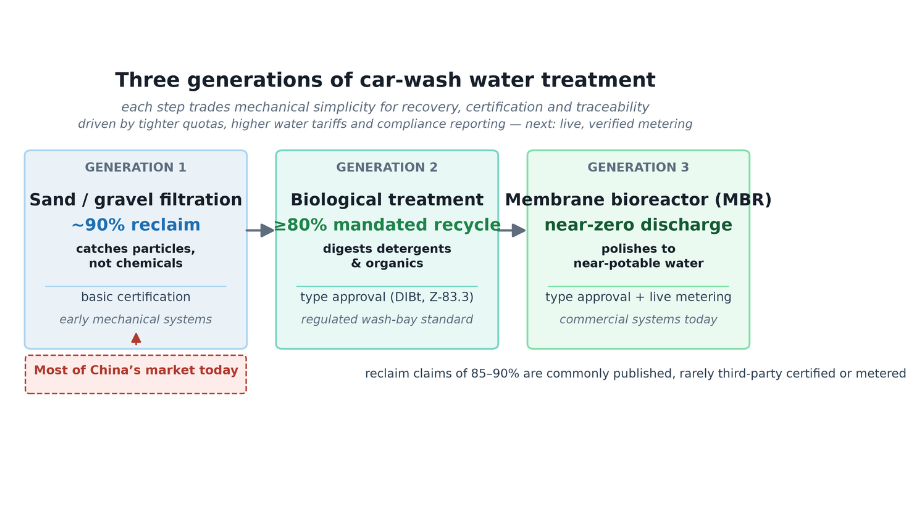
Fig. 5 — Three generations of car-wash water treatment. Sand filtration → biological treatment → membrane bioreactors, each step trading mechanical simplicity for certified performance, higher recovery and per-car metering — driven by tightening quotas, higher water tariffs and compliance reporting. Generation one is purely mechanical: it catches particles, not chemicals. Generation two adds biology that digests detergents and organics. Generation three polishes water to near-potable quality and meters every wash. Much of the installed base in China still runs on generation-one equipment, where 85–90% reclaim claims are published but rarely certified or metered.
Why does China run so much generation one? Because the test was having recycling equipment, not proving it, no type approval, no live metering. The leap is now feasible: certified biological and membrane systems are off-the-shelf, and the binding constraint is verification and maintenance, not technology.
6. Conclusion: the loop that keeps the station sustainable
Closed-loop water use is the rare investment that pays three ways at once. It saves, 18 liters instead of 100+, and the special-industry bill shrinks with every wash. It complies, the loop keeps the station inside the quota regulation now enforces, and outside the fine. And it earns, a wash bay customers queue for pulls them into the store and back to the pump, feeding station-wide cash flow as fuel margins thin, leaving the driver in a better mood, the cheapest loyalty program a retailer can run. Water saved, license kept, whole-station cash flow growing: that is how a recycling loop supports the sustainable development of China's 110,000 energy stations.
Written by Bob Liu, an independent advisor on mobility energy stations in Beijing. He spent more than fifteen years leading engineering and environmental standards for the China retail network of a Fortune Global 500 international energy company and holds an MEM from Tsinghua University.