Public Mobility Sites: Managing the Growing Complexity of Multi-Energy Service Stations
Ad
As Europe’s mobility landscape evolves, service station operators need a whole-site approach to building safe, reliable and adaptable multi-energy networks
As the European Commission reviews the Alternative Fuels Infrastructure Regulation (AFIR) in 2026, the question is no longer simply how quickly alternative-fuel infrastructure can be deployed, but how effectively it can be integrated into the places where mobility already happens.
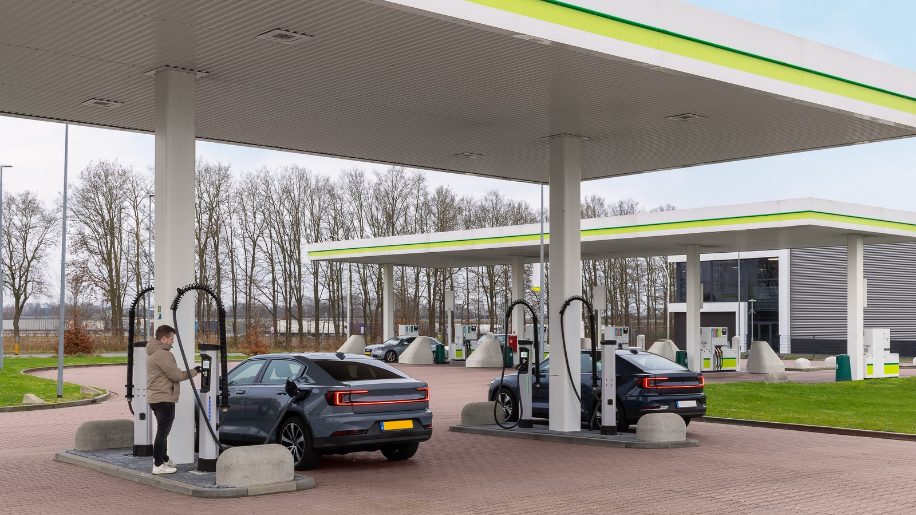
For service station operators, that complexity is already a day-to-day reality. Electric vehicle charging, alternative fuels and new electrical infrastructure increasingly need to sit alongside conventional fuels, often within sites initially designed for a very different mobility model.
Grid capacity, vehicle circulation, safety, civil works, payment systems and customer services all have to be considered together, while existing operations continue to run reliably. As service stations evolve into multi-energy mobility sites, their performance will increasingly depend on how well the whole site functions as one system.
Integrating new energies into existing sites
Existing service stations have one major advantage in the mobility transition: location. They already sit on established routes, attract regular traffic, and operate around proven commercial models. For many operators, upgrading existing sites makes more sense than developing new locations.
But those sites were not necessarily designed for the infrastructure now being added to them. Space is limited; vehicle circulation already follows established patterns, and underground tanks, pipework, and safety areas constrain where new equipment can go. Electrical capacity may also have been sized long before high-power charging became part of the equation.
EV charging makes these constraints particularly visible. AC suits longer stops, while high-power DC is increasingly relevant for motorists who need to get back on the road quickly. Either way, chargers are only the visible part: more capacity may mean new transformers, upgraded electrical distribution or a reassessed grid connection, all within an operating site.
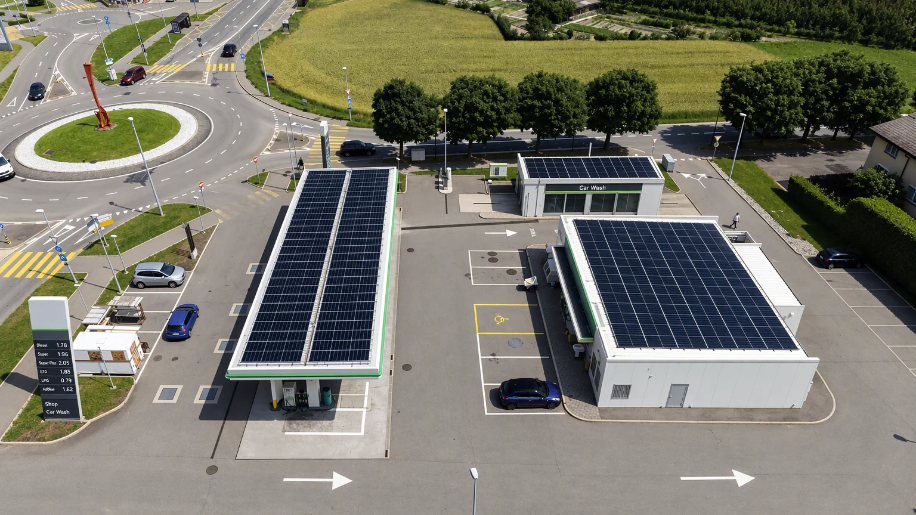
The same site-level considerations increasingly apply to renewable generation. In Slovakia, TSG has supported ORLEN Unipetrol with rooftop photovoltaic systems across operating fuel retail sites, including preparation of the existing electrical infrastructure, installation and connection of the solar equipment. TSG has also installed solar canopies across more than 70 fast-charging forecourts and hubs for TotalEnergies in France and Africa.
Much of this transition is therefore taking place within sites that are already in operation, where electrical capacity quickly becomes a central constraint.
Power is becoming the backbone of the mobility site
That reality is becoming particularly visible in the electrical architecture of service stations.
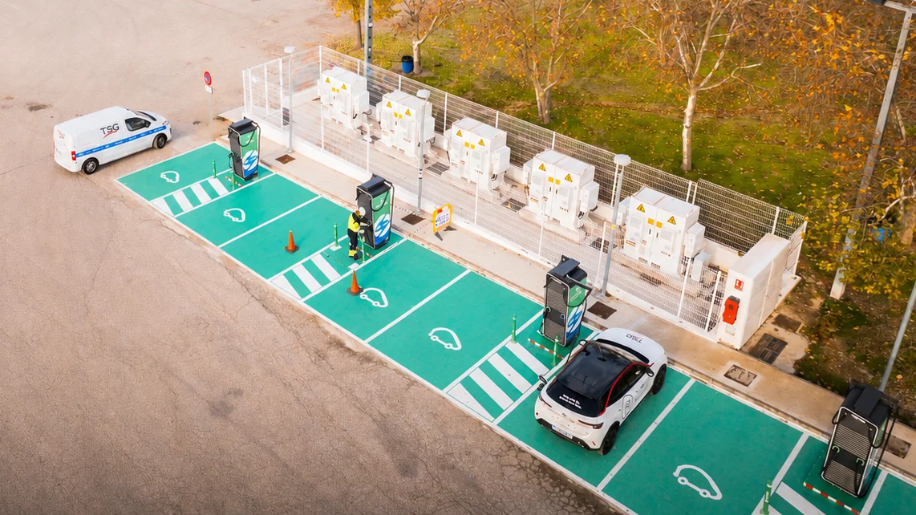
Before charging equipment is selected, operators need to understand the power already available, the site’s current consumption and how demand could evolve. Depending on the project, this can mean reinforcing the grid connection, installing high- or low-voltage infrastructure and transformers, or combining charging with solar generation, battery storage and energy-management systems.
Where grid capacity is constrained, storage can become part of the site’s power strategy. In the Netherlands, TSG and Pixii deployed three PowerShaper battery units to support a 150 kW fast charger on a site where the local grid connection could provide only 40 kVA.
Integrated with TSG’s EnergyHUB, the modular 150 kW / 150 kWh system stores energy when demand is lower and supplements grid power during charging peaks, allowing the operator to bridge the gap between available grid capacity and charging demand without waiting for major network reinforcement. Charging, building consumption, solar production, storage and other loads increasingly form part of the same electrical architecture.
There is also an investment balance to strike. Oversizing infrastructure too early can increase upfront costs, while designing only for today’s demand can result in costly modifications later.
Designing the whole site, not just the energy assets
Power may be central to the transformation, but it is only one part of a much wider site environment.
A multi-energy location may combine conventional fuels, EV charging, gas or alternative fuels, solar generation, storage, retail services and digital systems within the same footprint. Each has its own technical and safety requirements, yet all need to coexist without compromising accessibility, vehicle flow, maintenance or the reliability of the existing operation.
That makes an end-to-end view essential from the earliest stages, covering equipment positioning, electrical architecture, civil engineering, safety distances, maintenance access and future expansion.
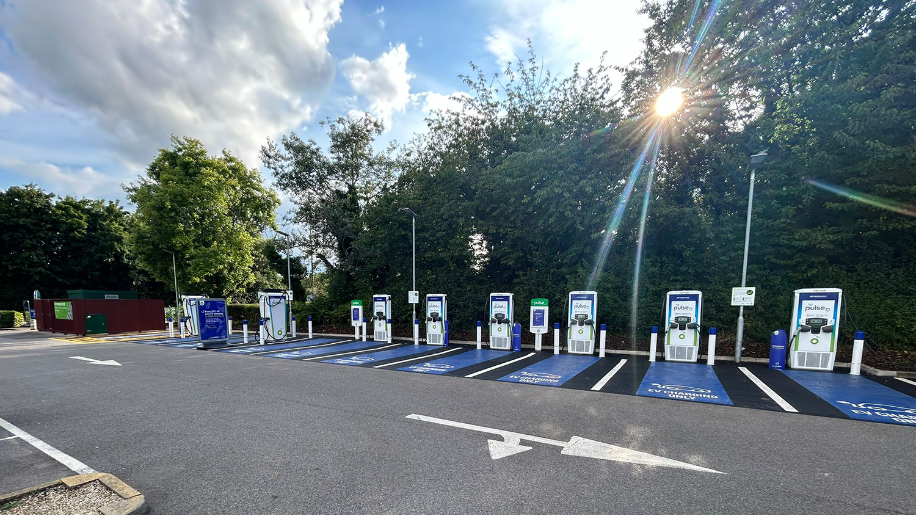
TSG’s ten-bay EV charging hub for bp pulse at an operating Marks & Spencer site in Cheshunt, UK, brings these considerations together. The project covered feasibility and design, civil engineering, a new high-voltage substation, charger installation and coordination with the distribution network operator, while minimising disruption to retail operations. The charging points may be the most visible part of the site, but their operation depends on the electrical, civil and operational infrastructure behind them. The same is true of the customer journey.
Conventional refueling usually involves a relatively short stop. EV charging can increase dwell time, changing expectations around parking, payment, retail and hospitality. Physical infrastructure and digital systems therefore increasingly overlap.
Operators may need to manage chargers alongside fuel dispensers, payment terminals, shop point-of-sale systems and site monitoring. TSG Systems already supports this connected environment across more than 20,000 sites equipped with point-of-sale or management systems, as well as payment solutions deployed across more than 150 charging hubs.
Connecting these functions can simplify day-to-day management while creating a more consistent journey across fuel, charging and retail services.
From individual sites to scalable networks
For operators managing multiple locations, the next challenge is scale.
Grid capacity, layout, planning constraints, customer profiles and existing infrastructure vary from one site to another. Yet networks still need common technical standards, predictable maintenance and consistent customer experience.
That does not mean reproducing the same infrastructure everywhere. The most useful model is one that combines repeatable technical principles with enough flexibility to respond to local conditions.
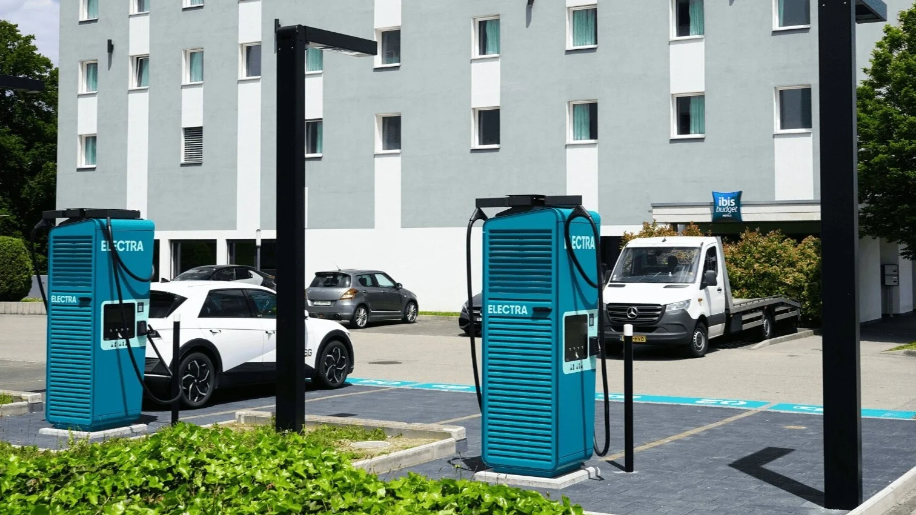
TSG’s work with Electra in Switzerland follows this logic. The Group supported the deployment of high-power charging infrastructure at two locations with very different characteristics: Gebenstorf, in a commercial environment, and Granges-Paccot, close to a motorway, hotel and leisure facilities. Both sites support chargers capable of delivering up to 300 kW but require different civil and electrical configurations adapted to their local environment.
Across wider networks, common standards and local engineering expertise can turn individual projects into a coherent investment programme. Maintenance then has to follow the same logic, covering the infrastructure as a whole rather than isolated assets.
No single model for the multi-energy service station
A motorway location may prioritise high-power charging, vehicle throughput and traveller services. An urban forecourt may need to integrate new infrastructure within a much tighter footprint. Others may combine conventional fuels with charging, solar or gas as demand develops.
What they increasingly share is greater technical complexity. Operators need to consider the complete site: its energy supply, electrical infrastructure, physical layout, safety requirements, digital systems, customer journey and long-term maintenance.
For TSG, this reflects the broader evolution of its activities. Building on long-standing expertise in conventional fuel infrastructure, the Group has expanded across electric mobility, gas, electrical systems, solar, battery storage and digital solutions, supported by local technical teams across Europe.
As service stations evolve into multi-energy mobility sites, the decisive question will not be which energy source replaces another, but how successfully different solutions can coexist within sites that remain safe, reliable, commercially relevant and ready to adapt.