Digital Signage as Operational Infrastructure at Mobility Sites
Advertorial
Mobility sites are changing rapidly. Fuel stations, travel hubs and roadside locations are evolving into multi service destinations that combine retail, foodservice, digital touchpoints and brand experiences. In this context, digital signage is no longer a peripheral marketing layer. It has become business critical infrastructure, shaping customer flow, dwell time, compliance and operational reliability.

As customer expectations rise and networks scale, operators face a growing challenge: keeping distributed digital systems stable, compliant and future‑ready — without increasing operational complexity or headcount.
Rising complexity across fuel retail networks
Across fuel retail and convenience networks, operators are encountering a similar set of pressures:
- Accelerating technology cycles
Connectivity standards, hardware lifecycles and software platforms change faster than traditional rollout models can absorb. - Limited real‑time visibility
Many digital signage estates lack a central overview of device status, connectivity and asset documentation, making proactive management difficult. - Operational and regulatory pressure
Safety inspections, documentation requirements and compliance obligations must be managed across hundreds of locations. - Lean operations, expanding estates
While networks grow, operational teams often remain deliberately small — scalability depends less on manpower and more on structured processes.
In such an environment, digital signage outages or delayed upgrades are no longer isolated technical issues. They directly affect brand perception, customer experience and commercial performance.
A mindset shift: from rollouts to operational intelligence
Leading mobility operators are rethinking how they manage digital infrastructure. Instead of treating digital signage as a sequence of one‑off rollout projects, they are moving toward workflow‑driven operating models.
The focus shifts from execution effort to operational intelligence:
How can systems detect issues automatically, trigger defined processes and create transparency — even when only a small team is responsible for a large estate?
This perspective allows operators to modernise incrementally, remain compliant and respond quickly to external change — without adding organisational complexity.
Case example: upgrading 800 digital signage locations with a two‑person team
A recent retail project illustrates how this approach works in practice. An operator managing 800 locations faced an urgent challenge when a previously used mobile network standard supporting its digital signage system was phased out.
Within three months, all routers across the network had to be replaced while locations remained fully operational. At the same time, the rollout included mandatory DGUV 3 electrical safety inspections, significantly increasing coordination and documentation requirements.
Notably, the entire project was planned, coordinated and executed by a team of just two people — a scenario increasingly common across fuel retail networks where operational efficiency is critical.
The complexity lay not only in the hardware exchange itself, but in synchronising locations, service partners, devices, inspections and reporting at scale, under intense time pressure.
Workflow‑based operations instead of manual coordination
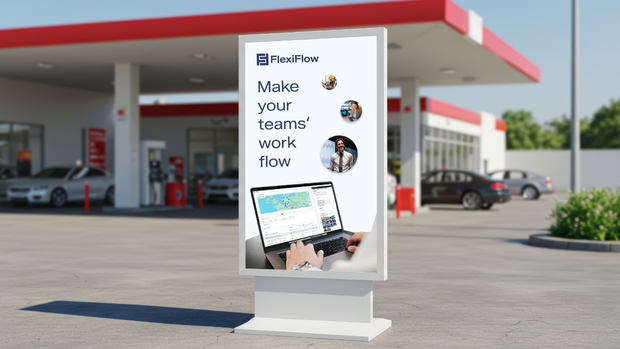
To manage this complexity, the operator implemented FlexiFlow as a central workflow platform for rollout and service operations, integrating it into the existing digital signage environment rather than replacing established systems.
As part of the project, an automated mechanism was introduced that triggers predefined service workflows whenever a player is reported as offline in the CMS, shifting incident handling from manual coordination to a structured operational process.
At the same time, the project generated a strategic asset: a complete, centralised documentation of the entire digital signage network — including devices, connectivity and safety inspection status — created as a by‑product of daily operations rather than a separate, manual effort.
Tangible business impact for operators
From an operator’s perspective, the results directly addressed today’s operational realities:
- Rollout completion ahead of the required deadline
- Full transparency across assets, locations and service activities
- Scalability without additional staff, despite managing hundreds of sites
- Improved system reliability through proactive issue handling
- Compliance handled at scale, without administrative overload
As one project stakeholder summarised:
“We now have a complete documentation of our digital signage network. Without FlexiFlow, delivering this project within such a short timeframe would not have been possible.”
Preparing mobility sites for the next phase
This example reflects a broader trend across the mobility sector. Digital infrastructure — from signage and connectivity to payments and EV services — is becoming deeply embedded in daily operations.
Platforms that combine workflow automation, system integration and real‑time visibility enable operators to manage this complexity pragmatically. They support modernisation without major rebuilds, reduce dependency on manpower and create operational resilience.
Rather than positioning technology as an end in itself, this approach illustrates how digitalisation can deliver measurable operational control — helping mobility networks run large estates efficiently and prepare for the next phase of transformation.