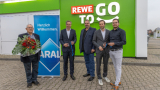
Aral opens Europe's first charging corridor for electric trucks
Eight 300 kW charging stations of Aral pulse will electrify 600 km of the Rhine-Alpine corridor, one of the busiest logistics routes in Europe.
The first charging corridor for battery-powered trucks in Europe was launched this week by Aral and the German Government in Bensheim, Germany. Aral is electrifying over 600 km of the Rhine-Alpine corridor with eight well-lit and safe 300 kW charging stations adapted to heavy-duty vehicles.
The Rhine-Alpine corridor is a heavily travelled logistics route that connects the Rhine-Neckar and Rhine-Main areas with the Rhine-Ruhr region, and other areas. Six stations are already active while in the coming months, two more in Bad Honnef and Cologne will complete the corridor.
At the Aral pulse stations, over 20 trucks per day can use green electricity to charge up to 200 km during the 45-minute legal driver stop, according to the company. Passenger cars can also use these charging stations.
“The discussion around e-mobility is currently very much focused on the passenger car sector. But medium- and heavy-duty traffic is also at a decisive turning point. Our strategy is designed to meet this demand with a corresponding offer. The first European charging corridor is an important milestone on this path, as it enables us to charge e-trucks, as currently most have to return to their home depot for charging,” explained Alexander Junge, Aral Board Member for E-Mobility.
The German truck fleet consist of over 3.5 million vehicles, and the number continues to grow. The vast majority still have combustion engines despite Germany’s efforts around hydrogen and BEVs.
"Today's inauguration of the charging corridor is an important building block in the decarbonisation of truck transport and at the same time a blueprint for what an efficient truck charging infrastructure for Europe could look like," said Nigel Head, EV Truck Director Europe at bp pulse.
“E-trucks will play a central role in regional transport as well as in long-distance transport. As with passenger cars, the switch to electric mobility can only succeed with a reliable and demand-oriented charging infrastructure. And we are moving at a fast pace, because the potential for climate Johannes Pallasch, spokesman for the management team of the National Charging Infrastructure Control Centre protection is huge and heavy-duty battery-electric trucks are now hitting the road,” said Johannes Pallasch, spokesman for the National Charging Infrastructure Control Centre.
Daimler Truck been on the market since 2021 with the battery-electric Mercedes-Benz eActros for heavy distribution transport. The eActros LongHaul for long-distance transport is scheduled to be ready for series production in 2024. The company worked closely with Aral with the aim of providing truck drivers with the necessary access and a comfortable charging experience.