As Payments Become Frictionless, Who Is Orchestrating the Complexity?
Ad
Payments have never been faster. But beneath the surface, mobility ecosystems are becoming structurally more complex. As fleets expand into hybrid and open-loop models, can your infrastructure keep pace with the complexity it creates?

Across fuel retail and mobility, innovation has largely focused on reducing friction at checkout. Contactless cards, mobile wallets, app-based fueling, embedded in-vehicle payments, and unattended POS environments have dramatically accelerated transaction speed and reshaped omnichannel journeys across service stations and convenience retail.
From the outside, the industry has made enormous progress. But in B2B fleet and commercial mobility environments, transactions are not consumer purchases. They are governed business events tied to drivers, vehicles, contracts, credit lines, pricing frameworks, tax logic, and negotiated commercial agreements. They do not end at authorization. They initiate a financial lifecycle that affects margin, risk exposure, settlement, billing, and reconciliation.
As front-end innovation accelerates, structural demands beneath it expand just as quickly. The industry has solved for speed. It has not yet been solved for structural complexity.
The question is no longer whether checkout is frictionless. It is who is orchestrating the complexity that now defines modern mobility payments.
Omnichannel Growth Is Increasing Structural Demands
Modern mobility ecosystems are inherently distributed. Transactions originate at the pump, inside the store, at EV charging stations, through mobile apps, across partner merchant networks, and increasingly inside connected vehicles through embedded payment credentials.
Each new channel improves convenience. Each also introduces distinct authorization logic, settlement timelines, fee structures, identity models, and operational dependencies.
In fleet environments, omnichannel is not only an experience strategy. It is an orchestration challenge driven by the need to coordinate multiple payment rails, energy types, balance models, and identification mechanisms within the same commercial relationship.
Consider a typical fleet scenario involving a plug-in hybrid vehicle. A driver refuels outside the proprietary network using an open-loop credential, later charges the vehicle at a public EV station, and purchases maintenance services from a partner merchant, all under the same fleet account. The experience appears seamless to the driver. Operationally, those transactions may clear under different rails, settle on different timelines, apply different pricing logic, and feed separate reconciliation systems.
Without unified orchestration across these flows, what appears smooth at checkout becomes fragmented in finance.
Open Loop Expansion - Opportunity and Structural Exposure
Open-loop adoption is often framed as a simple expansion of acceptance coverage. In reality, its impact is strategic.
When supported by the right orchestration infrastructure, open-loop enables fuel retailers and fleet operators to extend controlled payment credentials beyond proprietary networks into broader partner ecosystems, maintenance providers, toll operators, parking networks, lodging, and adjacent mobility services. This is not merely about enabling additional merchant access. It is about expanding the commercial perimeter of the fleet relationship.
With aligned architecture, retailers can bundle services across partner networks, apply differentiated commercial agreements, and consolidate billing under a single fleet account. Open-loop becomes a mechanism for increasing share of wallet without fragmenting the customer relationship.
However, expansion without structural alignment introduces exposure. Hybrid mobility is not simply the coexistence of open-loop and closed-loop payments. It is the simultaneous management of multiple payment rails, energy types such as EV and ICE, credit and prepaid balance models, cross-border activity, and diverse identification mechanisms, all within the same commercial framework.
In cross-border operations, for example, an open-loop transaction authorized instantly in one market may settle under different fee structures, tax treatments, and clearing timelines than a closed-loop fuel transaction in another. Without real-time normalization and orchestration aligning these flows, financial visibility weakens and reconciliation becomes reactive.
Hybrid mobility is not a temporary transition. It is the operating condition of modern fleet ecosystems.
Frictionless Without Orchestration Relocates Risk
The industry’s investment in frictionless checkout has been necessary. It has not eliminated operational friction.
In B2B fleet programs, a transaction must evaluate more than payment validity. It must consider vehicle type such as EV or ICE, contractual restrictions, driver permissions, merchant category controls, geographic parameters, credit exposure, or prepaid balance. When these controls are not orchestrated consistently across instruments, problems surface downstream.
Billing disputes often originate from misalignment between authorization data and settlement records. EV sessions, fuel transactions, and partner-merchant purchases may follow different reconciliation paths. Manual correction becomes routine.
Friction has not disappeared. It has moved from the point of sale into finance and operations. The real risk in modern mobility payments is not slow checkout. It is failing to orchestrate the complexity behind it.
Intelligence Embedded at Authorization
As transaction environments grow more diversified, behavioral variability increases. Expanded merchant categories, hybrid authorization paths, and embedded payment credentials generate patterns that static rule engines cannot manage effectively.
The issue is not the payment rail itself. Both open-loop and closed-loop models can operate securely when architectured correctly. The challenge is ensuring decision logic is orchestrated consistently and applied in real time across them.
In high-volume mobility ecosystems, machine learning models embedded within the orchestration layer enable behavioral analysis, predictive risk scoring, and adaptive policy enforcement at authorization. AI in this context is not a front-end feature. It is decision infrastructure operating beneath the transaction surface.
When intelligence is embedded directly into the transaction flow rather than applied retrospectively, exposure narrows and operational strain decreases.
Identity, Authentication, and Trust Across Channels
Everyone recognizes the situation where a fleet credential works at one location but triggers additional validation, or even a decline, at another. The issue is rarely authentication itself. It is fragmented identity logic.
In modern mobility ecosystems, identity no longer resides solely in a plastic card. It may exist as a mobile token, a vehicle-based identifier, an embedded in-car module, or a digital driver profile. In hybrid environments, multiple identity models operate within the same fleet relationship.
Trust depends on consistent orchestration. When identity is aligned across open-loop and closed-loop instruments, across EV and ICE transactions, and across every channel, complexity remains invisible to the driver while control remains intact for the operator.
Identity, in this sense, is not a channel issue. It is an orchestration issue.
From Payment Processing to Transaction Orchestration
The structural divide in fuel and mobility payments is no longer between payment methods. It is between processing and orchestration.
Payment processing enables acceptance. Transaction orchestration aligns and governs the entire lifecycle.
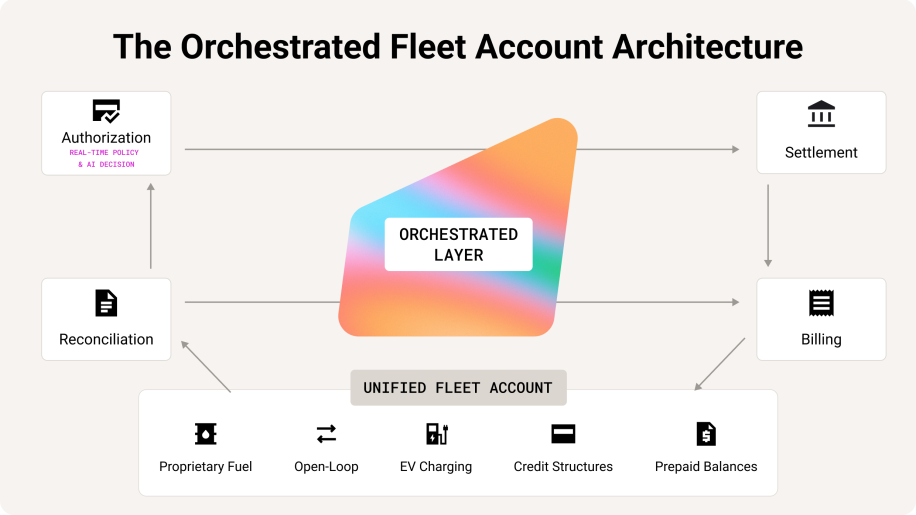
True orchestration requires a unified control and decision layer above heterogeneous infrastructures. It requires policy-driven authorization logic applied consistently across instruments. It requires real-time transaction indexing and visibility before clearing and settlement. At Reins, orchestration is not treated as an integration layer added on top of legacy systems. It is designed as transaction infrastructure — aligning authorization, settlement, billing, and economic logic under a unified fleet account architecture.
Most enterprise fleet programs we encounter were built on stable closed-loop foundations. That model delivers discipline and predictability. The challenge emerges when growth demands expansion beyond the proprietary network.
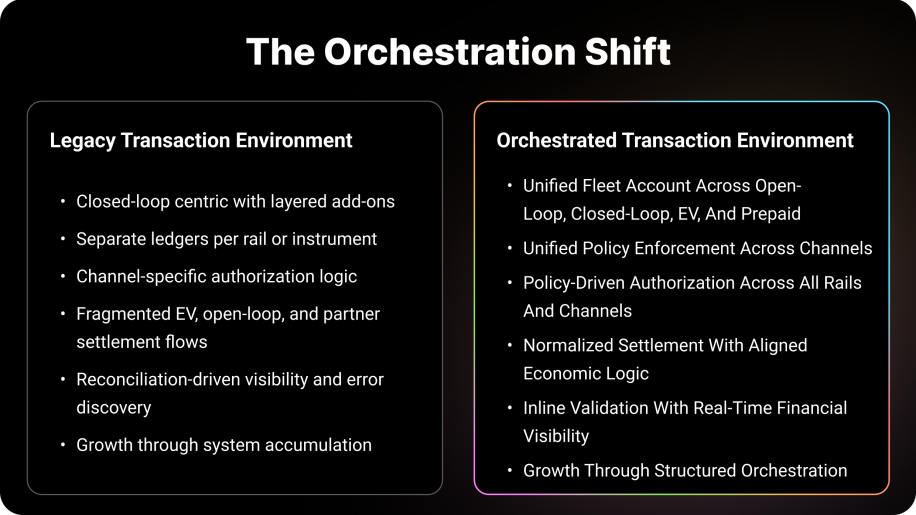
When open-loop capabilities are layered onto legacy stacks without architectural alignment, separate ledgers emerge, reconciliation flows diverge, and financial exposure fragments. What is positioned commercially as one account begins to behave as several.
A structured expansion model approaches open-loop differently. It aligns all transaction types within a unified account architecture from the outset. Proprietary fuel, open-loop spend, EV charging, credit-based exposure, and prepaid balances remain differentiated where necessary, but economically indexed to the same fleet relationship. Growth beyond the network should expand revenue without multiplying financial silos.
The Dynamic Ledger as a Structural Foundation
At the core of orchestration is a dynamic transaction ledger capable of supporting multiple business lines and identification models within the same fleet account.
A single fleet relationship may include proprietary fuel, open-loop transactions, EV charging, credit structures, and prepaid balances. In fragmented environments, each generates its own ledger. Billing, reconciliation, payment order generation, and collections operate independently. Financial visibility weakens as diversification increases.
A dynamic ledger architecture eliminates these silos. All transactions, regardless of rail, energy type, or balance model, are indexed under one structured fleet account while preserving differentiated pricing logic and settlement rules.
Automation in billing and reconciliation ensures that authorization data aligns directly with downstream financial flows. Payment orders and collections are generated from normalized transaction data rather than reconstructed after settlement.
Managing heterogeneous instruments within one orchestrated account is not incremental efficiency. It is an architectural discipline.
The Defining Question for the Future
Digital transformation and AI-driven innovation will continue reshaping payment experiences across service stations and convenience retail. Embedded payments will expand. Omnichannel journeys will mature. Intelligent authentication and tokenized identities will further streamline the user experience.
At the same time, mobility payment environments will not become simpler. They will become denser, with more rails, more providers, more identity models, and more settlement flows operating in parallel.
In this landscape, the defining question for the future of mobility payments is not how many capabilities an organization can add, but whether those capabilities operate as one coherent system.
Adding another payment rail, another open-loop program, another EV integration, or another financial tool does not in itself create competitive advantage. Without structural alignment, it creates fragmentation.
Profitable growth will belong to those who ensure that expanding ecosystems operate as one structured architecture, economically aligned, operationally synchronized, and orchestrated in real time. At Reins, this belief shapes how we design transaction infrastructure for modern mobility ecosystems.
The future will not be shaped by accumulation.
It will be shaped by orchestration.
Discover more at Reins - Reinvent Growth.