Evaluating the viability of acquisitions in Europe
Ad
The European fuel retail market is seeing a surge in mergers and acquisitions, presenting opportunities for strategic growth.
Alimentation Couche-Tard (Circle K) recently completed a landmark acquisition of 1,500 TotalEnergies' retail sites across Germany and the Netherlands. Significantly strengthening Couche-Tard’s footprint in Europe and underscoring a dynamic period in the fuel and convenience sector on the continent.
In another notable transaction, Shell initiated the sale of its fuel and convenience retail businesses in Norway to Finnish company ST1. This divestiture aligns with Shell's strategy to streamline operations and focus on core energy operations, illustrating a broader industry trend towards optimizing business streams through targeted acquisitions and sales.
With a plethora of fuel retail sites available for acquisition, network planning decision managers must carefully evaluate which sites offer the best investment potential. How can network planners assess the full potential of a site or portfolio quickly enough to outpace competitors?
Assessing site potential with Kalibrate’s 7 Elements Framework
Kalibrate’s 7 Elements for Fuel and Convenience Retail Success provide a comprehensive framework for measuring a site's potential beyond its current performance. By leveraging this framework, businesses can make informed investment decisions.
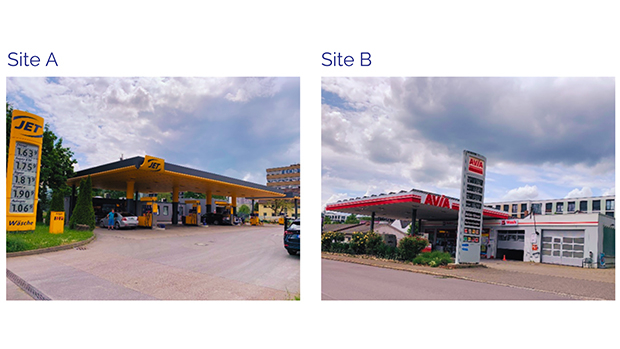
Consider two fuel stations on the outskirts of Stuttgart, Germany:
Site A
- Location: Busy road in a business district with a large residential area to the south.
- Facilities: Four pumps with 21 nozzles, a small bakery, and a car wash. Both fuel and shop are branded Jet.
Site B
- Location: Edge of a large residential area, 600m north of Site A.
- Facilities: Two pumps with 14 nozzles, a shop, bakery, car wash, and self-service delivery lockers. Both fuel and shop are branded Avia.
Comparative analysis
Using Kalibrate’s 7 Elements framework, Site A and Site B can be scored across various dimensions:
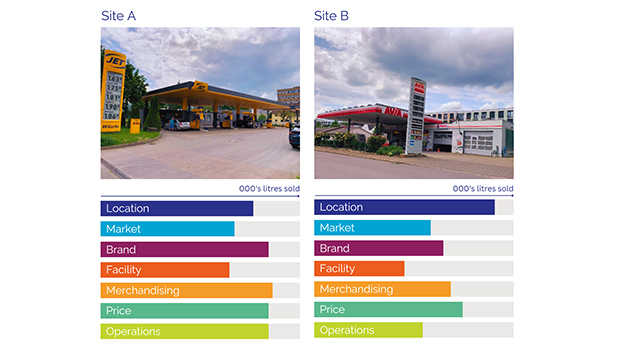
Although Site A outscores Site B in many areas, the high location score of Site B suggests a greater return on investment potential. Both sites show room for improvement in facilities, particularly in customer offerings and differentiation. Investment in these areas would have a positive impact on the overall site performance.
Leveraging mobility data
Analyzing mobility data reveals customer origin patterns for each site.
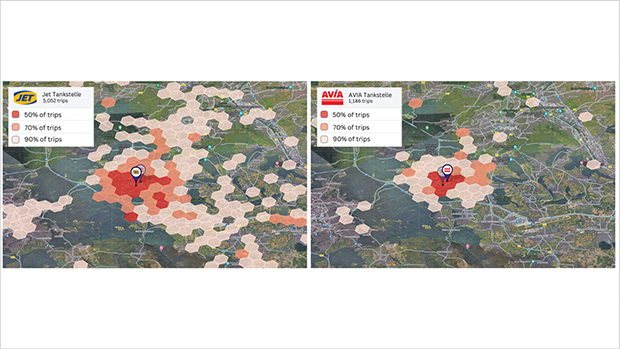
Site A attracts customers from a broader area, indicating a stronger offer that is better suited to the local market.
This data, combined with demographic and psychographic insights, helps create a comprehensive customer profile that sheds light on customer preferences and behavior. As well as enabling relevant and targeted marketing campaigns, understanding customers’ preferred products, shopping times, and payment methods allows retailers to fine-tune in-store services and ancillary offers that boost profitability.
Investment insights
Site A is already performing well with a large trade area, it would be a valuable acquisition that would immediately add to your network and can be further enhanced by improving in-store offerings.
Despite its smaller trade area, Site B has high potential due to its prime location. Strategic investments in facilities and operations could significantly elevate its performance, making it a cost-effective acquisition with substantial upside.
Unlocking site potential
Performance potential analysis is a vital tool in the arsenal of network planners.
Understanding the strengths and areas for improvement of every potential site, businesses can make strategic decisions that enhance their overall network quality and unlock the hidden value in acquisition targets.
Learn about Kalibrate’s performance potential analysis, or discover more about how Kalibrate’s analytical tools can drive success in the fuel retail sector.
Related content