EVs and eFuels – Both are needed for a sustainable mobility transition
Instead of pitting climate protection technologies against each other, the focus of climate policies must be on phasing out fossil fuels and using incentives to boost the deployment of all carbon-neutral technologies, including eFuels. Algara Castle writes about the huge potential of synthetic fuels in the future energy mix.

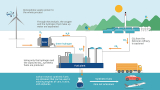
In the flat, barren, land north of Punta Arenas in Chilean Patagonia, ground was broken in September for the world’s first integrated, commercial plant to produce synthetic, carbon-neutral fuels on an industrial scale. The project plant called Haru Oni will harness the region’s excellent wind conditions to produce the electricity needed to make a climate friendly alternative to fossil fuels from green hydrogen – so called eFuels, which are emerging as a vital factor in the battle to reduce CO2 emissions in the transport sector. And on board for this pioneering project are amongst others SiemensEnergy, AME SpA and ExxonMobil, one of the largest U.S. oil companies – which are all members of the eFuel Alliance.
Like other leading players the Texan oil major is preparing for the inevitable and investing heavily in renewable energy projects, because one thing is becoming more and more clear: The era of fossil fuels is being consigned to history. The European Union, the new U.S administration, and China have all committed to tackling climate change. Across the world, the details of the policy programmes may be different, but the vision is the same. Institutional investors can see the way the wind is blowing, are shifting out of fossil fuels and trying their hand at green and sustainable finance. If oil companies want to stay relevant, they have no choice but to adapt their businesses and contribute to this transition.
Transport, which still heavily depends on fossil fuels, has a key role to play here, as it accounts for one fifth of global carbon dioxide (CO2) emissions, and thus holds great reduction potential. Various technologies are available to curb road emissions, and big oil companies are exploring them: As electrification will undoubtedly be an important building block, companies like BP are making multi-million-dollar investments in the development of fast-charging batteries and charging infrastructure for e-vehicles. However, there are limits to the requirements for mobility that can be satisfied by battery-electric vehicles alone. For long distances and heavy duty, where electrification is neither an economically or technically viable option due to the current battery size and its short range, the hydrogen-powered fuel cell can be considered as a possible alternative. But economic factors will limit the roll-out of new and expensive infrastructure. That is why the combustion engine will continue to play a role – whether we like it or not.
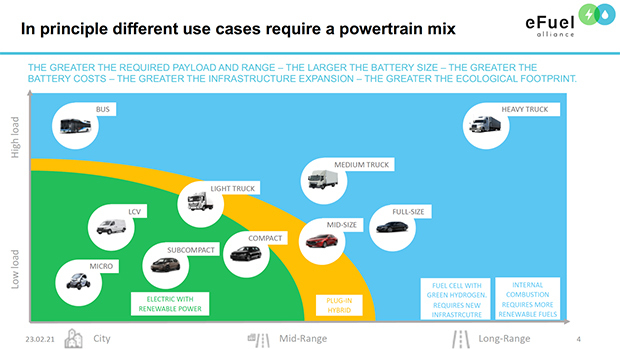
But here is the good news: the internal combustion engine (ICE) can also be operated in a climate-neutral way. That is because it's not the combustion technology itself that matters, but the energy carriers that it combusts. Unlike fossil fuels, eFuels do not release additional CO2, so they are almost climate-neutral in the overall balance. In the transport sector, the use of eFuels as a climate-neutral alternative to fossil fuels could therefore lead to a significant reduction in CO2 emissions.
eFuels are suitable for all means of transport powered by an ICE, such as cars, trucks, aircraft, ships, and can provide a climate-neutral option in cases where the market ramp-up of electromobility faces challenges (e.g. infrastructural issues, electricity price increase, lack of customer acceptance) or is unfeasible for the foreseeable future as in hard-to-abate sectors such as aviation and maritime. They can be blended into conventional liquid and gaseous fuels such as petrol and diesel and, as larger quantities of eFuels are gradually added, and production costs fall over time thanks to economies of scale, eFuels can be affordable for consumers in every phase.
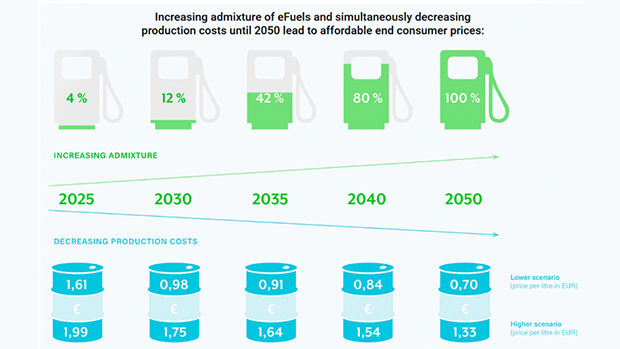
Deploying eFuels in road transport would also allow the existing current fleet of more than 1,4 billion vehicles worldwide to be better integrated into climate protection efforts. For example, an EU-wide blending of just 5% eFuels to conventional fuel in the year 2030, would result in a saving of 60 million tons of CO2 – equivalent to taking 40 million cars off the road for an entire year.
In addition to the roll-out of e-mobility, eFuels should therefore be granted a complementary role in defossilising road transport. Instead of pitting climate protection technologies against each other, the focus of climate policies must be on phasing out the use of fossil fuels in all sectors and creating effective incentives for the production and deployment of all relevant carbon-neutral technologies, including eFuels. A recent survey by the opinion research institute Forsa in Germany proves the point: 60% of the respondents would choose a car with combustion engine, powered by eFuels, to drive in a climate-friendly way.
And the versatility of eFuels extends their reach beyond transport: They can also be used as feedstock for the industrial chemical sector and provide a climate-neutral alternative to conventional heating oil. Given that around 20 million heating systems in the EU run on conventional liquid fuels, eFuels can contribute to significant CO2 reductions in the building sector and in domestic heating, sparing lower-income households high conversion and renovation costs by keeping the oil-fired boilers running – but in a climate-friendly manner.
This wide range of applications for eFuels explains why they make sense both for climate protection and economic reasons. Alongside the expansion of e-mobility, eFuels can make a significant contribution to CO2 reduction in the transport sector. At the same time, the investment and job-creation potential of eFuels is huge – in research and development, in mechanical and plant engineering and, last but not least, in securing the future of the automotive industry. In Germany alone, the production and export of power-to-X technologies and plants could generate €36.4 billion in additional value added per year and create almost half a million new jobs.
Yet, to leverage the potential of eFuels, regulatory incentives must be created to enable their market ramp-up as quickly as possible. The European Green Deal offers a unique opportunity to set the necessary legislative framework and create a business case for eFuel production. Three legislative plans presented by the European Commission in July will be key to creating immediate market demand for eFuels and triggering the investment needed for their market introduction:
The revision of the Renewable Energy Directive
In its proposal to revise the Renewable Energy Directive, the European Commission seeks to increase the share of renewable energy in transport and to introduce a specific sub-target for so-called renewable fuels of non-biological origin (RFNBOs) to promote the use of hydrogen and hydrogen-based products such as eFuels in the transport sector. The eFuel Alliance welcomes this, though we fear that the level of ambition is insufficient to provide the incentives for investment needed to significantly advance the defossilisation of transport. In the context of a coherent EU climate strategy, we will therefore advocate in the coming weeks and months for more ambitious targets of 5% eFuels in 2030, a cross-sectoral and broad usage of sustainable renewable fuels and longer planning horizons beyond 2030 to provide more legal certainty, as this is vital for large-scale projects.
CO2 emission standards for cars and vans
While the Renewable Energy Directive regulates the supply side for renewables, market-based instruments such as counting eFuels towards EU CO2 fleet targets should complement and strengthen emission-reduction efforts on the demand side. The eFuel Alliance therefore encourages the EU Co-legislators, the European Council and European Parliament, to introduce a crediting system as part of the revision of the CO2 emission standards regulation. This instrument would unlock additional volumes of renewable fuels, enable extra GHG reductions in transport, and thus ensure effective climate action. It is the only option to set a vehicle with an internal combustion engine climate neutral. More options to meet the requirements under the CO2 emission standards will also have a positive impact on costs for consumers in all EU member states, enabling a fair transition to carbon-neutral mobility.
Reforming European Energy Taxation
As part of a comprehensive EU climate policy, we also believe that an overhaul of current energy taxation is long overdue. If energy tax is levied on an environmentally relevant tax base, it will promote the use of sustainable, clean fuels instead of conventional fossil fuels and thus support the market ramp-up of eFuels. Under the current Energy Taxation Directive, fossil and eFuels are treated equally – a clear contradiction of climate ambitions. The EU Commission's latest proposal to reform the EU Energy Tax Directive points in the right direction. However, we would have liked to see a harmonised approach in which renewable fuels in road transport would also benefit from better treatment than fossil fuels in all Member States.
This is a critical moment in the battle to curb climate change, and a vital opportunity to move forward collectively must not be missed. Together business leaders, policy makers and environmentalists must take a pragmatic approach to achieving the goal that everyone now wants – from Berlin to Bejing. And that means giving eFuels the chance to play their part in averting a climate change catastrophe. Now is the time to make sure that Haru Oni in the remote reaches of Chilean Patagonia is the first, rather than the last, project of its kind.
Written by Algara Castle. The eFuel Alliance is committed to the expansion and promotion of the global production of eFuels and to their widespread use in many sectors.