Hyundai Motor Group presents its vision to popularize hydrogen by 2040
Hydrogen Wave represents Hyundai’s plans for a new ‘wave’ of hydrogen-based products and technologies toward a hydrogen society.
At the Hydrogen Wave global online forum held this Tuesday, the automotive manufacturer presented its plans to popularize hydrogen by 2040 through the introduction of new technologies and mobility solutions in transportation and other industrial sectors.
The company plans for the electrification of all new commercial vehicle models – featuring fuel cell electric or battery, as well as fuel cell systems – to all models by 2028.
The Hydrogen Wave activities kicked off today with an online presentation – led by Chairman of the Group, Euisun Chung, and other senior executives.
“We want to offer practical solutions for the sustainable development of humanity and with these breakthroughs, we aim to help foster a worldwide Hydrogen Society by 2040,” said Chairman Chung at the Hydrogen Wave online global forum.
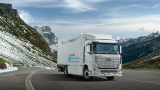
Since the development of its first FCEV in 1998, the Group has been preparing for the future of hydrogen. In 2013, the Tucson FCEV (ix35 Fuel Cell) was introduced, opening the door to the mass production of FCEVs. Then, in 2018, the company launched the next-generation fuel cell SUV, NEXO, and the world’s first heavy-duty fuel cell truck, XCIENT Fuel Cell, in 2020.
According to the Hydrogen Council, a global CEO-led initiative of leading energy, transport, industry and investment companies, hydrogen energy will account for 18 percent of global energy demand by 2050, with a market size of USD 2.5 trillion. The popularization of hydrogen energy will also help cut CO2 emissions by more than six billion tons a year, while creating over 30 million new jobs.
During Hydrogen Wave, the Group also unveiled the ‘Trailer Drone’ concept, a hydrogen-powered container transportation system capable of operating fully autonomously, with a double e-Bogie configuration.
Through the development of hydrogen commercial vehicles, the Group will promote the complete transition of Korea’s public transportation and logistics systems to hydrogen-based solutions.
Third-generation fuel cell system
Currently in development, the third-generation fuel cell stack will succeed NEXO’s current stack. At the event, the Group showcased two power versions of the third-generation fuel cell stack: 100kW and 200kW. The 100kW stack has reduced in size by an astounding 30 percent, making it 70 percent in size from the current generation stack to make it easier to apply to different vehicle types and applications. The 200kW version has been designed for commercial vehicle applications and is similar in size to the current NEXO system, but the power output has doubled.
For the second-generation fuel cell stack launched in 2018, the company achieved 5,000 hours and 160,000 kilometers of usage, which is similar to the warranty of an ICE vehicle. For the third-generation fuel cell development, the goal is to improve durability by 50-100 percent. High durability stacks for commercial vehicles will achieve 500,000 kilometers of drive range. Furthermore, the price of the third-generation fuel cell stack will be dramatically reduced – with projections being upwards of more than 50 percent – which will be the key factor to achieving cost parity of FCEVs with BEVs by 2030.
“The degree and frequency of environmental disasters is rising fast and we now face a code red warning for humanity,” added Chairman Chung during the global online forum. “The Group seeks to offer powerful and pragmatic solutions for combatting climate change via the tremendous potential of hydrogen energy.”
At Hydrogen Wave the Group presented its vision for future hydrogen mobility across several vehicle applications, from emergency relief and rescue, through to autonomous container transportation and high-performance sports cars.