Q&A with Richard Campion (Visa): "The mobility ecosystem seeks to simplify payments"
In this exclusive interview, we sit down with Richard Campion, Head of Fleet & Mobility at Visa Europe, to explore Visa's innovative approach to fleet payments and mobility solutions.

Question. How do you think the fleet card business has developed over the years? How is Visa trying to fit into that ecosystem?
Answer. I found out recently that one of the fleet card operators' processing platforms is the same age as Visa, which is just over 60 years old now. This gives you a sense of the scale and size of the infrastructure that is in place regarding fuel cards today. However, the demands on fuel cards are changing significantly, and I think EV serves to highlight part of that.
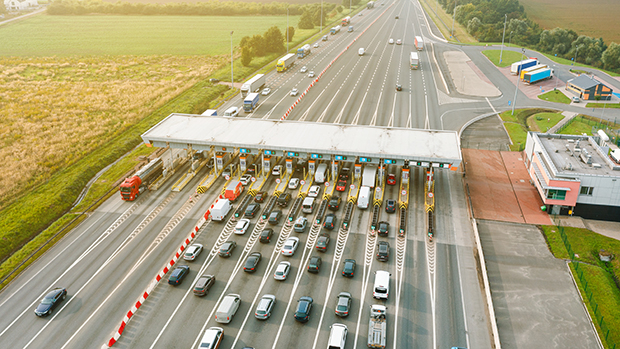
There are also ancillary requirements for payment needs such as parking and tolls. As you move into mass transit and alternative formats of mobility, the ideal is to have one payment mechanism that can cater to all those needs. Drivers are often frustrated at needing to use multiple cards including their own to cover all their expenses, which also has the knock-on effect of making it more difficult for fleet operators to track spend. But I’m also conscious that you can’t just have an unlocked payment card.
Having a payment card with the right spending controls is essential, as is having one that is suited to today’s digital world. One that can be loaded into a phone for instant issuance when a new driver starts a shift and is contactless enabled for easy payment. These are all capabilities that are coming to the fore now. We have built the Fleet 2.0 proposition to cater to the evolving needs of fuel card users today and in the future.
Q. It’s a time of uncertainty for fleet owners and the mobility industry in general. How do you help fleets navigate the mobility transition?
A. I don’t think anyone has a crystal ball here. We need to build solutions that have an element of future-proofing. These will be the solutions that succeed moving forward, reducing the need for huge tech projects every few years. I know that cost pressures exist for fleet operators and fleet card issuers, so a future-proofed solution is likely to be most relevant.
If I link it back to what Visa is doing, Fleet 2.0 is designed to make the transition to mobility easier for the industry. We’re essentially equipping fleet owners with an all-in-one solution that simplifies both drivers and operators lives. The card can be used for any travel expense, and with it being on one card, tracking and reconciling spend is simplified. Plus, Visa is accepted at over 100 million merchant locations globally, providing a vast choice for where that card can be used, both in physical locations and e-commerce transactions.
Q. Can you help bridge that gap between fleets and charge point operators to achieve a similar payment experience to fueling?
A. Certainly, we can. We see an increased adoption of Visa cards for payment of EV charging transactions, and the number of charge points that accept Visa cards is increasing every month. It’s a rapid deployment rate.
However, it's not just about tapping a card and moving on from a transaction; it's about the other services surrounding it. We bring together a range of different partners who can support some of the ancillary services needed on top of a payment card, such as expense management and CO2 reporting.
Q. With all that data I guess you can provide valuable insights to clients.
A. The Visa fleet card can offer significant insights into fleet efficiency. We take all the data from a standard Visa transaction and supplement it with enhanced data needed for a fleet card. This includes the number of kilowatts or liters pumped, future-proofing for hydrogen, the length of time the vehicle was stopped for an EV charge, how long it was charging, the speed of the charger, the odometer reading, and the vehicle registration number. All that information provides valuable insights to Fleet Operators which can be used to drive efficiency gains, calculate CO2 impact and reduce reconciliation costs.
Q. Another thing you are working on is in-car payments. There’s quite a lot of movement happening in this space. What potential do you see for connected vehicles, fleets, and Visa?
A. I view the vehicle as another form factor. We’ve seen various form factors emerge over the years – your phone, watch, and various items in your home. The vehicle is just another one.
When we get to the point of having payments in vehicles at scale, we need to ensure that those payments are secure. Adopting Visa’s tokenization capabilities is essential for securely storing credentials within the vehicle. Once you have that payment credential in the vehicle, it opens up numerous use cases.
Parking and tolls are fundamental, and vehicle refueling is a powerful use case – being able to identify which pump you’re at and unlocking it while remaining in the vehicle, is significant. Additionally, vehicle servicing and maintenance are other areas that could benefit. Security of the payment within the vehicle must remain central.
Q. There was a recent from Mercedes-Benz and Visa to roll out in-car payments. Do you expect a lot of growth in this segment? It seems to me getting some momentum after previous efforts.
A. I believe this will scale significantly in the coming years. Many vehicle manufacturers have made similar announcements about embedding payments within vehicles. The Mercedes one was particularly interesting because it adopted both Visa’s tokenization and authentication capabilities.
Where additional approval is required for a transaction, we can use the vehicle's functionality to provide that. Having the payment credential in the vehicle opens up various use cases.

Q. Security plays a huge factor in payment systems. What are the main things you focus on to ensure security for fleets?
A. If we think about how payment technology has evolved, we started with swipe machines, then magnetic stripe cards, chip and pin contactless cards, and virtual cards on top of that, including tokenization. Each step has enhanced security levels.
From a Visa perspective, we track hundreds of thousands of transactions in real-time, monitoring them for various levels of fraud. We must remain at the forefront to ensure transactions are secure.
Q. Fleets have started to integrate with broader MaaS platforms to include ride-sharing and micro-mobility. Does that add more layers of complexity? How do you see this trend?
A. It definitely adds complexity. The more use cases you open up, the more challenges you create regarding spending limits and controls. On the positive side, having one Visa card used across all micro-mobility and MaaS providers offers flexibility for refueling, EV charging, parking, tolls, and other needs.
It's also crucial to track data for that. For example, when calculating CO2 footprint, we need to ensure it accurately represents the mode of transport used. Similarly, those cards must be efficiently locked down or opened up to different spending categories as needed. When we designed Fleet 2.0, enabling quick locking and unlocking of different spend categories was key.
Q. What are the medium-term goals for Visa's Fleet 2.0 service?
A. We’re seeing many of the trends Visa has highlighted around mobility being recognized by fleet operators. Plus, it’s not just fleet operators anymore; corporates are also looking at mobility benefits as a total package.
We are seeing Visa’s Fleet solution being adopted by fuel card providers, lease companies, charge point operators, and employee benefits providers. The mobility ecosystem is seeking to simplify payments and the Visa Fleet card can support this.
Written by Oscar Smith Diamante