Poland's convenience boom: Inside the race to redefine the everyday stop
Glass towers, rotating doors, and a convenience store on every corner: Warsaw is the unlikely set for the next chapter of European retail.
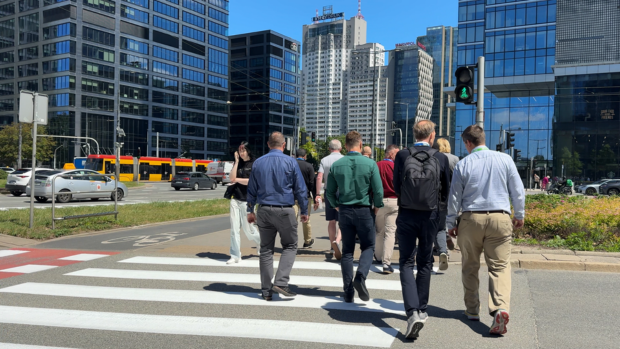
Let's start with the setting. A fully rebuilt city that at times looks Kraków and others Atlanta. Tall glass towers populate Warsaw with the spirit of a thoroughly modern urban core — supermarkets, cafés, restaurants and gyms tucked below 30 stories of flats and offices. Heavy doors invite you in, often in an annoying rotating fashion, through buildings laid out like an urban maze. "The toilet for the Shell Café?" I ask. "Out the back door, through the lobby, and on the left." It's the perfect setting for the opening chase scene of a Bond film, except instead of Aston Martins, picture glass doors and convenience stores, with the convenience store playing the lead rather than the sidekick. We're here for NACS Convenience Summit Europe, and Warsaw spent the week proving why it earned the booking.
That's not an accident of geography. In 1989, Poland was poorer than Gabon and Suriname. Today its GDP per capita sits around $52,000, roughly level with Spain and the UK, the product of the longest uninterrupted growth run anywhere in Europe. That compressed climb didn't leave room for the slow, layered retail evolution Western Europe went through. It produced something closer to a leapfrog: Poland now has more stores per million inhabitants than any country on the continent — nearly 1,920, almost double Portugal's count and well clear of the UK's roughly 1,025 — most of them small-format outlets built for speed and proximity. "The Polish market has changed completely over the last ten years," says Sami Nachawati, Pre-Sales & Consulting Director at Comarch. "It was a place for testing innovation. Right now, it's a place where innovation is born."
The shopper behind those numbers is busier and more price-aware than the density alone suggests. Discount stores now see the average Pole roughly fourteen times a month, more than any other channel and still climbing; convenience stores are close behind, at over nine visits a month and also rising. Eighty-five percent of Polish consumers actively seek out promotions, and over a third say they'll switch stores entirely chasing a better one. Yet sizeable majorities also say they'll pay more for fresh, preservative-free food, for safety guarantees, or for products with clear local origin. It's a market that rewards both the cheapest run and the best one, often from the same shopper in the same week. Underneath sits an aging, shrinking population which is quietly pushing every major retailer to think as much about loyal regulars as about new footfall.
Leszek Jurczak, a member of NACS' Global Industry Engagement Council, frames the market through its leaders rather than its averages, though the leaderboard runs deeper than two names. Discounter Biedronka, founded by the same entrepreneur who later launched Żabka, anchors the food-basket channel alongside fast-growing rival Dino, while local banners like Lewiatan and abc still operate thousands of stores apiece in towns the national chains haven't fully reached. But it's the convenience and fuel categories where the gap turns extreme. "We have absolute leaders," Jurczak says. "Żabka has almost 13,000 stores, and the number two on the market has only 600." The fuel side follows the same pattern: Orlen runs around 1,900 stations against BP's 600. Both companies, Jurczak argues, have converged on the same insight: the future of convenience is food. "We are talking about food for now and food for later. People eat three times a day and fuel up maybe once a week. If your customer comes to your shop three times a day, that builds a loyalty no fuel program ever could," he says.
The frog that ate the market: Żabka's flywheel
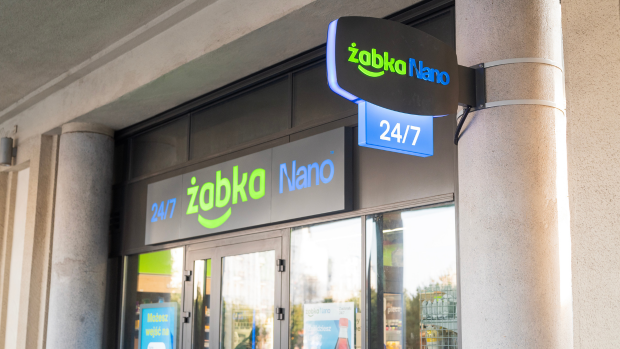
Żabka's growth is a flywheel story. Twelve thousand three hundred stores across Poland and Romania, around three new openings a day, and an October 2024 listing that ranks as the fourth-largest IPO ever on the Warsaw Stock Exchange. None of that growth happened by accident; it's been built on three reinforcing pillars: a retail media network running off the foot traffic the stores already generate, the Żappka app, with 10 million users acting as the connective layer across loyalty, coupons and delivery, and Nano, its camera-tracked autonomous store format. Nachawati points to one detail from that ecosystem as the clearest signal of where Polish convenience is heading: "We see the largest convenience store in Poland introducing the smallest gaming controller in the world, connecting it within the mobile app and the physical world. That's really interesting." It's loyalty rebuilt as a game, not a punch card.
The company's own language traces a three-stage evolution: corner shop, "Galaxy" with ready solutions for the entire day, and "Multidimensional Life Center," adding a pharmacy function here, a post office function there, until the store stops being a stop and becomes a destination with its own daily rhythm. That model is now crossing borders. Under the Froo banner, Żabka has opened more than 200 stores across six Romanian cities. Poland's biggest convenience chain has set the bar that everyone else on this market, fuel retailers included, now has to clear.
Jan Kisielewski, Brand & Customer Strategy Director at Żabka, explained how they use scale, proximity, data, innovation and a deep understanding of customer needs to build a modern convenience ecosystem that includes food delivery and quick commerce.
Betting on every pump: Orlen's all-fronts convenience play
If Żabka grew up convenience-native, Orlen arrived from the other direction. It's first and foremost an integrated multi-energy company, with four business segments spanning upstream supply to renewables, and convenience sits inside a Consumers & Products division built around 3,750 sales and service points and roughly 15 million retail customers. The breadth of what it's testing at once is the point. "It seems like the strategy of Orlen has been to attack every single front at the same time," I put to Agnieszka Bobrukiewicz, who leads the group's non-fuel business. She doesn't push back. "The biggest challenge was really to have unification between the markets," she says. Orlen now runs seven countries through a single Group Convenience team, holding roughly 70% of the offer consistent across borders while still letting innovations launch simultaneously and feed back into each other.
What that looks like on the ground was two minutes from where we spoke, the Hilton in Warsaw. The site includes vending machines selling flowers and cakes, an extended coffee zone where customers build their own iced drinks, new zero-alcohol and no-sugar ranges. The barista program now stretches to espresso tonic, matcha, and seasonal pistachio and gingerbread lattes, aimed squarely at a younger customer the brand didn't used to chase this hard, even as older generations continue to account for the larger share of everyday spending nationally. Ask Bobrukiewicz what's driving it, and she points to the product rather than the technology. "The quality of the product. That's the most important thing in the Polish market. The expectation from our customers is really high level, so we are trying to give them the best possible quality and innovation,” she adds. With around 11,000 EV charging points, Orlen is also making a quieter bet: as charging times stretch, the station stops being a five-minute stop and becomes somewhere worth lingering.
The format experiments go further than any one station can show. Fully automated smart stores are already running in Germany, and a separate smart-store format developed in partnership with COOP is live in the Czech Republic, both built to scale across markets rather than stay local pilots. Vending has become its own quiet category, designed to give people a reason to stop even when the tank is full: dual-category machines selling flowers and desserts off the same impulse logic, more than 15,000 pickup points and over 670,000 parcel-locker compartments, and 67 bottle-deposit machines.
NACS CSE and the bigger picture
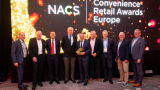
None of this plays out in isolation. At NACS Convenience Summit Europe, Henry Armour, Chairman Emeritus and CEO International, urged retailers to double down on their own strategy and escape "the sea of sameness." Among the big ideas on display: computer vision quietly watching shelf conditions, the rising commercial value of retail media, and a blunt acknowledgment that the store remains the last analog frontier left to digitize. One session walked through what that actually means on a Tuesday morning shift: a camera flagging an empty peg where the protein bars should be, a price tag on the shelf edge that doesn't match what the register charges, a promotional sign still up three days after the promotion ended. That's the friction the industry is racing to engineer out, store by store, shelf by shelf.
Brian Gray, Managing Director at Accenture, sketched where that's heading at scale, walking through the use cases fuel and convenience retailers are already leveraging: AI camera and voice analytics for personalization and loss prevention, operational control centers acting as a kind of air traffic control for the store network, merchandising optimization for demand forecasting and shrink reduction, and dynamic pricing tuned for margin and volume in the same motion. Most of that is already running somewhere on a Polish forecourt or shop floor. Poland isn't waiting for these ideas to arrive from elsewhere. It's one of the places they're being proven.
Poland is a compressed, high-speed version of a fight every convenience market is now having. "We are on a good path to be one of the leaders globally, maybe one of the top three in Europe," concludes Jurczak. The organizations are there. The innovation is there. What could stop Polish retailers?
Written by Oscar Smith Diamante