OG Clean Fuels: The operator betting on a clean multi-energy future
MobilityPlaza sat down with Jellina Waringa, Director of Corporate Affairs for OG Clean Fuels, to trace the company's evolution from a Dutch Bio-CNG startup into one of Europe's most ambitious clean fuels networks, and to understand why the company believes the road to net zero runs through a multi-fuel approach, not a single silver bullet.
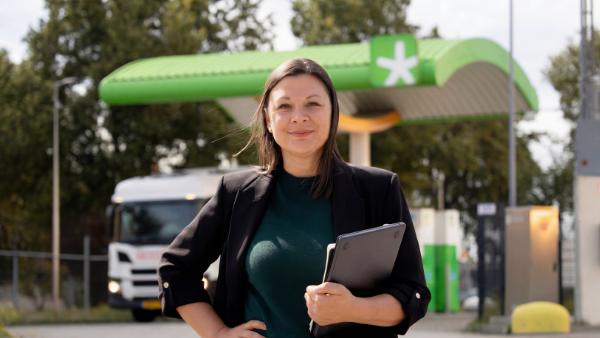
Founded in Heerenveen in 2008, OG Clean Fuels did not start with a grand pan-European vision. Its earliest ambition was simpler: bring Bio-CNG to Dutch drivers. Within six years it had built 65 stations across the Netherlands and made its first move into Germany; a decision that, in hindsight, defined the company's trajectory. "Germany is now our biggest market, and we're definitely the market leader," Waringa says. The German foothold was followed by Sweden in 2019, Italy in 2023, and then, in a pivotal step that came with France in November 2025. Through the acquisition of Proviridis, OG added 19 strategically placed multi-fuel stations along the Paris–Lyon–Marseille corridor.
That French deal was the first major deployment of capital from Pioneer Point Partners, the London-based sustainable infrastructure investor that acquired OG in March 2025, committing over €150 million to fuel the company's growth. OG now operates around 400 stations across five countries, with an ambitious target of €500 million in annual revenue within five years, reaching 700 stations and, adding one or two new markets.
Spain and the UK are the markets Waringa says are under the closest scrutiny right now. It is not a coincidence that both have substantial road freight activity. "We don't go for a specific fuel and then find the market for it," she explains. "We look at market conditions and how our products would fit. It's a patchwork of demand, supply, and legislation that differs enormously from country to country."
A multi-fuel answer to a multi-fuel problem
That patchwork logic explains why OG stopped being a Bio-CNG-only company a long time ago. The current product portfolio spans Bio-CNG, Bio-LNG, HVO100, EV charging, and hydrogen. Each fuel serves a different segment and a different set of operational requirements. HVO100 is, in Waringa's words, "the entry-level biofuel" — the one that allows fleet operators to meaningfully reduce their carbon footprint without changing vehicles or infrastructure. Bio-LNG is growing across Europe but remains subject to price volatility that makes it less predictable than BioCNG as a procurement proposition.
It is Bio-CNG that Waringa describes as OG's star product right now, and the reason is straightforward: supply certainty and price stability. The company has locked in long-term fixed-price supply agreements in the Netherlands and Germany, which means customers can plan ahead with a known cost and a committed carbon intensity score. "Companies can count on us. They know exactly what they're buying, for a long term, and also in terms of quality," she says. That reliability, as much as the environmental credentials, is what fleet operators actually need.
Bio-LNG's renewable share in the European heavy transport sector has made significant gains, with three out of four litres of LNG now coming from renewable sources in 2024, a dramatic leap that underscores the direction of the market even as policy struggles to keep pace, according to IEA. Bio-CNG, meanwhile, benefits from a more mature and geographically distributed production base. As of 2025, Europe already had around 4,000 CNG stations and 700 LNG stations in place, according to the European Alternative Fuels Observatory, providing a foundation on which operators like OG can build commercially viable networks.
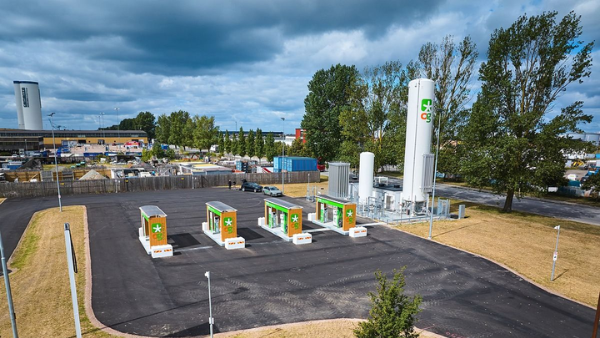
Not all 400 OG stations carry the full portfolio. What the company calls Dream Stations, flagship sites offering at least three fuels in a single location, are the physical expression of this multi-fuel philosophy, built where market demand for several clean fuels converges.
Hydrogen remains a longer-term proposition. Waringa is candid about its current limitations: the total cost of ownership is still too high to be viable for most transport operators. But she is equally clear that OG is tracking its development closely and intends to be ready when the economics shift.
The feedstock question. Why it’s a policy problem, not a supply problem
One of the most frequently raised objections to biomethane as a scalable fuel is the availability of sustainable feedstock. Waringa does not dismiss the concern, but she reframes it. "The feedstock is not the issue," she argues. "It's what you do with it. If feedstocks aren't available, that has more to do with policy constraints rather than them not being there." OG participates in broader industry coalitions that carry this argument to Brussels, pushing for investment frameworks that encourage the collection infrastructure and logistics needed to unlock what is, in their view, a structurally underutilised resource base.
This argument is backed by wider industry analysis. The European Biogas Association and NGVA Europe have consistently argued that biomethane production in Europe can scale substantially with the right enabling conditions, and that feedstock scarcity is a governance issue as much as a physical one.
The regulatory race: The Automotive Package & RED III
The most consequential policy terrain for OG right now is the EU’s Automotive Package, which looks to support the sector's efforts in the transition to clean mobility. The Package signals a meaningful shift in the Commission's posture. For cars and vans, manufacturers will need to meet a 90% tailpipe emissions reduction from 2035, but the remaining 10% can be compensated through the use of e-fuels and biofuels, effectively keeping internal combustion engines and plug-in hybrids. On heavy-duty vehicles, the Commission is also proposing to ease compliance flexibility on the 2030 CO2 targets. The framework is explicitly framed around "enhanced technological neutrality,” language that sits very close to what OG and its industry allies have been arguing in Brussels for years, and which creates structural space for fuels whose climate benefit is real but measured on a well-to-wheel basis rather than at the exhaust pipe. "The direction is encouraging," Waringa says, "but speed is the challenge, and Brussels moves slowly."
The most significant recent development in that debate came from Germany, where the government signalled support for vehicles running solely on eligible fuels, that would effectively carve out a regulatory home for BioCNG and Bio-LNG trucks beyond the current tailpipe-centric framework. "That's a very good step in the debate. It could have been us saying that," Waringa says. If the concept gains traction at the EU level, it would force a more systematic engagement with well-to-wheel accounting.
The well-to-wheel argument has been gaining ground slowly. "You can see it drip into RED III," she acknowledges, "and it is becoming more apparent in discussions." The logic, as she states it, is ultimately about what problem Europe is actually trying to solve. "If it's EV that you want, yes — tank to wheel. But if it's CO2 reduction that you want, which is eventually the goal, then it's well to wheel. The science will catch up."
Fleets, OEMs, and the absence of a diesel die-hard
Despite 375 of OG's 400 stations being open to the public, most of its customer base are fleet operators, except for Italy where you can find 80% of Europe’s CNG-powered passenger cars. In conversation with logistics companies, Waringa finds a consistent picture: the willingness to decarbonise is there, the concern is clarity. "I have never had a conversation with a transportation company where they said: I just want to drive diesel because I don't care about the environment. Never." What operators want is a fuel solution that works economically over the long term and helps reduce CO2 emissions.
OEMs are similarly positioned. Those that OG speaks with want to build vehicles that sell, and they increasingly recognise that a policy environment forcing investment into a single powertrain creates exposure. "There are OEMs who have invested a lot in electric vehicles and they simply don't sell," Waringa observes. Any regulatory move toward technology neutrality, is therefore also a commercial preference for vehicle manufacturers who want to continue developing ICE vehicles alongside battery and hydrogen options.
Ten years from now
Asked where she sees road transport energy in a decade, Waringa's answer is clear: "Hardly any diesel left. And hardly any brown electricity left either." The aspiration is a market that has found the right clean solution for each application, and OG being positioned to serve whichever solutions those turn out to be. On biomethane specifically, she’s bullish: "I would be very, very surprised if it didn't play a significant role. Biomethane is such a smart product, especially from high-quality feedstock, where you have negative emissions. You're going to be silly not to use it."
Written by Oscar Smith Diamante