"We are the perfect bridge to the future energy state" Pete Davis, CEO GreenPrint
Along with Trenton Spindler, Pete Davis co-founded GreenPrint in 2014 with the aim of offering fuel retailers and corporate fleets a profitable way of curving carbon emissions. We discuss the company´s new program with 7-Eleven, the different ways to neutralize fuel emissions, and how free-range eggs marked the beginning of GreenPrint.

Could you explain what is GreenPrint and what does it do?
We run reduced fuel emission programs for fuel retailers, corporate fleets and a few other industries. On the retail side, we calculate tailpipe emissions per gallon and type of fuel, and then we invest in projects to neutralize those carbon emissions in the atmosphere. These programs are then certified and audited by a firm.
The idea is that we live in a purpose driven economy where consumers and other stakeholders are driven by a higher purpose. They are thinking about electric vehicles, low emissions vehicles and such. We work with retailers to provide a competitive differentiator. A method to allow customers to drive their existing cars with less of an impact on the environment. We create a custom branded program for our client, we market it at the pump and through digital and other mechanisms explaining how much emissions they are cutting, or with slogans such as “Pump here. Plant a tree”.
Do you always plant trees as part of your programs?
The reason why we use the tree language so often is because consumers understand the message – they get it. In school we all learned how trees breathe in carbon dioxide and release oxygen. In locations where trees are not so necessary we focus on reducing carbon emissions in the atmosphere, or supporting and investing in alternative energy projects like solar power and hydroelectric. When it comes to trees, it is not only about planting, we also focus on protecting mature forests as large trees have a much bigger impact on the environment.
With the rise of electric vehicles and alternative fuels, low margins at the pump and people in general are becoming more aware of environmental issues. Do you see more interest coming from traditional retailers in a program such as these?
Many car manufacturers, including new ones like Tesla, are investing in different low emission technologies; politicians are also discussing these issues. I think we provide a perfect bridge to that future energy state. The program doesn´t require any software or hardware, there is no new tanks, no new vehicles required – it is automatically applicable to anyone driving a vehicle. With climate change and these issues in the news every day, there is more demand for our products, and we’ve certainly been seeing a spike in interest for retailers implementing a reduced emissions program.
How did the initial idea of GreenPrint come about?
I spent most of my career in the loyalty business. My company was working with banks, airlines and retailers. It started when Kroger (a large American retailer) asked us to integrate a loyalty program into their fuel centres – many people at that time were earning triple points when they bought gas. I started to think about the gasoline category and came to realize how commoditized it was, and how for most retailers fuel made up for the majority of their transactions but represented a much lower percentage of the profit. And how retailers were competing on price, on the penny.
That night, before I went home, I stopped by for some groceries. I paid an extra dollar for free range eggs, instead of the usual ones. Then I did the same with a carton of organic milk. That got me thinking how these products had reinvented themselves to not compete on price but on something more, which fits into the purpose driven economy. Customers don´t focus on price so much because the value proposition has changed. For most people, the biggest problem with fuel are emissions and the possible impact they have on the environment. Three years ago we founded GreenPrint with the goal of creating programs that will help retailers have a competitive differentiator and change the value equation of their products.
Generally, when you go to a retailer to discuss the benefits of GreenPrint, are they more drawn by the environmental benefits or the marketing side of it?
Almost half of our business is dealing with corporate fleets that have trucks, in that part of the equation they are more attracted to the program by the environmental aspect of being greener and sustainable. Retailers, on the other hand, are more focused on increasing sales and profit. For them is about changing the value proposition, like a convenience store that sells barista coffee and is able to charge more for it because of the quality, while creating stronger customer loyalty. We enable our clients to sell an environmentally friendlier fuel – we put a little green leaf next to the pump, we have signage at the point of sale that informs about the initiative and they reap great rewards. Month over month the volume of sales go up, customers are less price sensitive, they talk about the program with their friends and family… There is a number of tangible benefits to the program.
How do you adapt to the local conditions of each retailer? Do you do different projects depending on where you are?
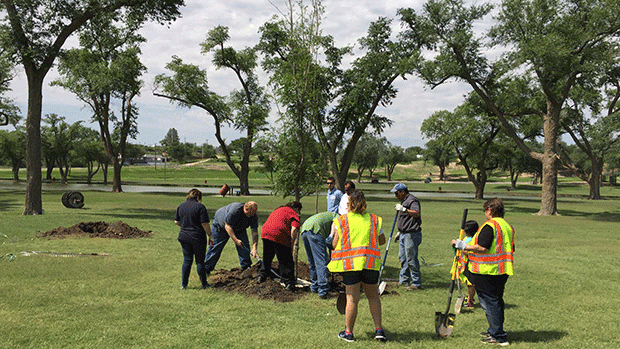
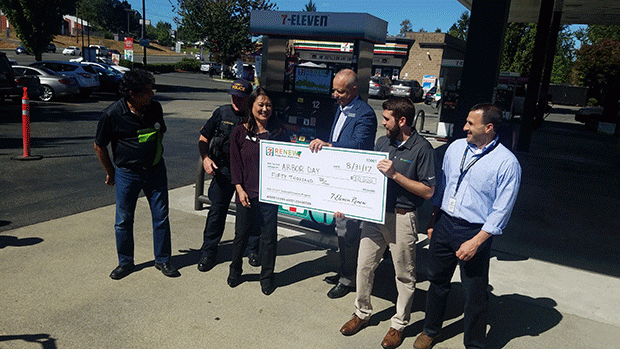
First, we adapt the project based on the desires of our client – what they want and what they need. We customize each program based on their interest and location. We built a software that helps us track transactions by location in order to localize investments. We have just launched a program with 7-Eleven in three different markets. When someone buys fuel (at a 7-Eleven) in Seattle, most of the green investment will be dedicated to the city and the State of Washington. We plant trees around the State as well as in parks and schools of the city. In addition to neutralizing carbon emissions we do work in the local community. We have a network of around 2,000 non-profit organizations that we engage to find local projects for each program.
You have recently partnered with 7-Eleven to develop the RENEW program. What are the characteristics of the program? And how is the relationship with a large retailer like 7-Eleven?
They have been fantastic so far – we have a shared vision. The program that we have created for them seems to fit well with their corporate sustainability goals, and the belief that we live in a purpose driven economy where consumers want to see this from companies. The ‘RENEW’ program currently includes 93 locations with fuel services in three different states (Washington, Oregon, and Wisconsin). We calculate and reduce tailpipe emissions by 30% through a mixture of investing in certified carbon dioxide programs and local tree planting. We only launched a couple of weeks ago but we are already seeing strong results. If people see the value, they will visit the store more frequently and become more loyal.
Your company was present at the NACS Convenience Summit in London to promote GreenPrint in Europe. What are the biggest challenges for you to enter Europe and what difference do you see with the U.S.?
So far we are present in Europe on the fleet side but we are still to make our mark on the retailing sector. In general, our experience with commercial fleets has been great. We are getting a great reception. Europeans are much more advanced when it comes to being green and environmentally friendly. Our biggest challenge is that we are based in the U.S. so all of our efforts are from the distance. We probably need people in Europe to put a bigger effort and more energy. We are in discussions with a few European retailers but there is nothing tangible so far.
Interview by Oscar Smith Diamante